I am not a great fan of the opensource movement. I had been always asking for a reality checkof opensource movement potential. Several months back, I covered the perspective, Open Source software which does not make commercial sense, or at least indirectly contribute towards the commercial strategies of the software vendors and their corporate markets, is doomed to a dead end. As I wrote earlier, for some the monopolistic domination of few commercial vendors may make the open source movement look desirable, fact remains that in the modern world, efficient use of capital,creativity and innovation are the key to sustained success – that is what commercial technology enterprises strive to accomplish. The few recent acquisitions of opensource vendors have not in my opinion changed anything substantial. As Tom Foremski points out, the software giant could stop much of the open-software movement dead in its tracks through acquisitions, and stifle the rest of it by making it difficult to recruit a developer community. No group would want to do free development work for Oracle–if it turns out that Oracle could very well acquire the open-source company in the future? In general, the open-source communities would not be motivated to act as unpaid developers for Corporates. Period. George Ou raises a key point – The response won’t be so lackluster if Microsoft went out and bought OpenOffice.org which competes with Microsoft Office or if Microsoft bought out Open-Xchange which competes with Microsoft Exchange server.Chances of failure withHostile controls are always very high. As i see it, even existing users of opensource woule be worried about the change of character of the opensource movement, deserting it further. These moves would dent at the push and pull effects of opensource. It is clearly the case that arresting loss of potential business seems to be the motto in these acquisitions –not necessarily building new business around the acquired product. Opensource leadership is determined by a sense of camaraderie, bonding and fostering collaborative leadership. I do not think that brand value or community network strength would hold good as an important facts if the fundamental characteristics gets changed , as in the case of opensource acquisitions. With lot of these purchases happening at the commodity level – lower end of the stack, the faint hope hope of these acquisitions triggering chain of innovation in the enterprise software also looks far fetched . In the long run, these developments would be seen as merely tactical and would be treated as such.
Read this interesting note written by Daniel M. Harrison speculating acuisition of Sun by Google. Amongst other things, the fact that the numerous option excercising and sale of stock insiders at the company have been carrying out recently - only last week, Chairman Scott McNealy relieved himself of roughly ten million dollars in Sun equity - and it all seems a little too coincidental. Some related facts : - Google stock has been experiencing a number of non-disclosed acquisitions. Sun has had investors exiting to the tune of eight figures on a market cap of ten. - Microsoft meanwhile, sits more comfortable than both at a price/earnings way below the industry average and with a product - Windows Vista - which everyone is talking about coming out later this year. These kinds of anomalies are typical in the behaviour of companies where acquisitions have been strategically arranged and are still in the 'preparation' phase.
This is pure speculation based on a few co-incident events & ought to be seen that way only. While I can't say with any amount of certainity about this happening - I do not think that this is not plausible considering the state that Sun Microsystems is in today - atleast a divisional buyout looks plausible. But real decisions are generally taken on entirely different set of considerations.
John Doerr, Ray Lane & Ram Shriram were in India last month and addressed a few meets. The well publicized TiE Bangalore event titled- “"Entrepreneurship – yesterday, today and tomorrow" had KPCB’s John Doerr & Ray Lane presenting along with angel investor Ram Shriram of Sherpalo presenting to budding Indian entrepreneurs. The Presentations - the trio made therein have been made available online now.
John Doerr presentation titled – "Ideas Are Easy , Execution Is Everything" makes interesting reading. Look for the slide on Mercenaries Vs Missionaries and the points internet is underhyped, India will be the third largest consumer economy in the world and India is insurmountable opportunity.
I have been tracking Ray Lane's perspective on the enterprise software space for sometime and found Ray's presentation titled – "KPCB In The Software Industry" equally interesting. Ray lane builds on the growth opportunities in the enterprise software space –web enabled enterprise opportunities and enterprise software adoption – Read his presentation along with this groundbreaking note that I covered earlier.
Ram Shriram's presentation titled – "Consumer Internet – Web 2.0" is a very appropriate theme for india base entrepreneurs to study deeply. Ram thinks that wireless is a game changing opportunity and is gung ho about mobile data markets. See my recent note on mobile data markets and this mobiles as change agents. Alongside read this and an excellent note titled sixteen ways to think about Web 2.0. Also read my earlier note here wherein amongst other things I noted that more than 95%( again my estimates based on feel) of these setups have primarily come from within the US.Kudos to the technology leadership that the US is showing here - Forget Asia or Europe - initiative, speed and zest for trying out in the tech sector still remain a US vestige - Good for America and by extension good for the world. Its action time in India right now. Lets hope breakthrough big deals and innovative enterprises spring out of this momentum.
For quite some time, I always felt that innovation would be felt more rapidly and in a much more pronounced way in the mobile technology /business arena. Courtesy of Krzysztof Kowalczyk saw this interview.Michael Mace,ex -Palm, Apple etc.. has an excellent take on the future opportunities in mobile space and his observations on the valley are interesting - insightful thoughts.
- Silicon Valley has grown through a series of failed companies. They grow up big and then explode, scattering employees who create new firms all over the place. Those people then find creative ways to work together in their new roles. Years ago in semiconductors, Fairchild exploded and scattered the seeds for many of the major chip companies you see today. Netscape blew apart and put a bunch of Internet-savvy people in companies all over the Valley. Apple shed thousands of employees before and after Steve Jobs came back, and today you see Apple alumni in most of the consumer-related tech firms – Palm, Logitech, Yahoo, Google, etc.
- I think there's incredible room for innovation in the mobile data market, both smartphones and other sorts of devices. But I'm not sure who's going to deliver it. The best mobile devices combine hardware, software, and online services (RIM Blackberry being a great example). Most companies don't know how to build that sort of integrated solution. That's why you see so many devices loaded with features that please technophiles, but don't sell in volume to normal users. The situation is so bad that some of the operators and handset companies have started to write off mobile data in general.
- I wish the VCs in Silicon Valley were more interested in funding new hardware companies. Most of them like to invest only in software, so you don't get many device startups.
His blog also looks interesting – subscribed straightaway. The next big thing in the consumer electronics sector, would be centered on mobile technologies.That's the reason why many find windows mobile very hot. With developments and advances like these, we can definitely expect lot more things to happen in the mobile space in the near future.
Fred Wilson earlier wrote venture capital is patient capital.Highlighting that even the most patient investors can get tired of supporting an investment, often called "deal fatigue", he points out the typical life cycle of a venture deal is five to seven years. The returns in ventures can be negative in the early years, get positive in year 3 or 4, and then grow from there, typically called the J curve – this can also show the typical annual cash flows of a startup company.They are negative for two to four years, turn positive, and grow from there, thereby creating value for the entrepreneurs, operators, and investors. Other way to put it - The IRR curve over time for an early stage VC fund – that period of time in advance of mass-confirmation of a new idea. Nick points to the classic J-Curve available from the CalPERS site. CalPERS report points out, in practice, a private equity portfolio involves a series of J-Curves because funds are invested in at different times. However, not all funds will be profitable given the inherent risks of investing in private equity, including macroeconomic factors and the performance of underlying companies. Deal fatigue is driven more by money than time and it can be a very destructive emotion in the board room if it is not managed properly. As Fred sees it, there are ways to avoid them: - First, don’t let the J curve flatline. Get profitable in a reasonable period of time. Two to three years is typical, five years is too long. - Second, bring new investors into the syndicate every time you raise money. The investors who wrote the checks in the A round might be tired by the E round, but the D round investors will have fresh legs. - Third, start with a low valuation and slowly and carefully build it in each investment. The investors will be less tired if they see the value of their investment increasing in each round. He cautions that there is nothing worse than a tired investor with a paper loss on his or her hands. With increasing expectations of private equity,this makes an wonderful read - amazing dosage of wisdom.
Strange are the ways that laws of trade impose discipline and instill neccessity on people, society & nations. Assocham, an apex indian trade body believes that IT and ITeS, one of the largest sectors in the Indian economy could become potentially become the biggest drain on India’s foreign exchange reserves.Already a net importer and with huge energy needs emerging, this could be bad news for India. According to Assocham estimates, IT industry will require computer hardware worth $77bn by ’10 against the industry estimated exports of around $60bn. A major part of which is expected to be met through imports if hardware manufacturing doesn’t pick-up in India. Assocham say that the growth of the Indian economy in the next ten years (’05-15) is estimated to increase electronics demand to $159bn in ’15 from the current level of $11.2bn. But given only a tiny portion of this demand would be met from local production. Its to be noted that Indian electronics production stands at 1.7% of India’s GDP in contrast to that of. South Korea’s 15.1%,Taiwan’s, 15.5% and China’s 9.6%. I do expect that India would begin to focus in hardware & hardware related production very aggressively from now on. Recently C.K.Prahalad pooh poohed the view that India may not be a force in manufacturing - he does not rule out India emerging as a major manufacturing centre. People assume it is all going to be just software, and knowledge-based, but India will invent a different kind of manufacturing - very high quality, design-centred and software embedded. Hopefully , the next generation chip design shall see significant contribution coming in from facilities set up in various indian locations.It is more you design, you develop, you manufacture, you ship. This is still in its infancy, but I expect it to grow as rapidly as the software side. This, I believe is a cosmic intervention - given the entrepreneurism & dynamism that we now currently see in India - we shall see huge investments and efforts getting channelised towards building/scaling up the industry within the country.
Courtesy of Bill Burnham saw this announcement about buying on googlebase. While Google Base provides data structure and distribution for a wide range of content and information,a subset of items are for sale. To help users more easily purchase and sell Google Base items, we're planning to enable people to buy items on Google Base using their Google Accounts. For buyers, this feature will provide a convenient and secure way to purchase Google Base items by credit card. For sellers, this feature integrates transaction processing with Google Base item management. This may not be good news to eBay trying to promote paypal as the standard for online payments. Google Base will now allow merchants to feed all their listings to Google for free and just take a cut of transaction. Just thought what could be the challenges for Googlebase: whatever applicable to Paypal is applicable to Googlebase as well : – First is Execution – as it is growing like crazy. – Second is the external environment - lots of regulators, lots of associations, and the importance of compliance for a financial institution. – Competition – particularly well entrenched eBay. In terms of payments, this service competes with everybody and it's a much more openly competitive environment
Bill points out, It stands to reason now that Google has essentially completed the infrastructure it needs to launch a Pay-Pal equivalent which one has to believe is now rather far along in its development and will be launched sometime in 2006. In fact, another post on Google's official blog provides the emerging reality therein. In a follow-up post, Bill highlights that Google is apparently the merchant of record in these purchases. This contrasts with EBay’s approach – they have avoided being the merchant of record for transactions on its site. The merchant of record typically takes responsibility for all charge backs, fraud, etc. Google claims that all transactions processed are non-refundable, but if they are processed via credit cards that is not the case because the issuing bank can always refuse to pay the merchant bank and the merchant bank will typically then stick the merchant with the so-called charge-back. This may point to a few things including Google’s desire to lay the groundwork for Escrow service and launching a merchant bank issuing its own branded credit cards. Net-Net there is a significant difference between eBay’s & Google’s approach towards payment processing – we shall have to see the implications on these account as things unfold.This also brings closer to reality predictions made a while ago about Gemaya, - in particular,Google, and possibly Microsoft and others, attempting to develop their own online payment services to match eBay’s PayPal. And lets wait for the second part - eBay will almost certainly morph PayPal over time into something that looks more and more like a multi-functional consumer bank to become true or would Google jump step the process and be there first.
Innovation would be the mantra for growth & survival for enterprise software players, including those seen as walking dead – In the valley it is innovation driving the growth.Vertical search gets a welcome boost from a company you may not have heard of. David L. Margulius writes about innovation happening inside large enterprise users and points out even in vertical search arena, t Google could not come up with vertical search - search that does a better job of finding results in a given domain because some human know-how’s been applied to limit the results set? While guessing that it may be seen as boring compared with all the other fun things Google’s been doing. But in any case, good old Fidelity Investments beat them to it with http://fidelitylabs.com fidelitylabs, a “financial search” beta that searches only financial Web sites. He highlights that Fidelity to FedEx (innovator in IT-driven logistics), Dell (IT-driven supply chain), Wal-Mart (POS data and RFID) and a few others provide a basis to offer a cogent counterargument to the Web 2.0 hype machine. VMware’s progress in the last 1-2 years – today EMC is said to be beating numbers owing to VMWare’s tremendous performance in the market. The continual advances of the SaaS segment, BPM segment all makes one hopeful of seeing more innovation and progress happening in the enterprise software segment as well. I recently wrote,atleast in respect of the enterprise software, which is closer to the heart of CIO’s its clear – as I had always been telling - while vendors are addressing market realities to keep their industry vibrant and with http://123suds.blogspot.com/2005/04/enterprise-software-market-new.html consolidation fever ahead - one could clearly hear the voice :whether customers would benefit a lot because of this, add the need to make more innovation happen and absorb faster. No,I am not talking about Marc Benioff finding SAP innovation free, while I certainly agree with his perspective that observers tend to overestimate the creativity and innovation that entrenched technology companies can bring to a particular problem and underestimate the effect of business-model conflicts that lurk behind the scenes ( as applicable to all majors). Innovation need not not be always of the disruptive type but every type of Innovation counts. In today’s hypercompetitive world ,simply put innovation is non-negotiable and innovation streak is of very high value to enterprises.
In diagnosis for disruptive technologies,I covered earlier, “disruptive innovations typically take advantage of "asymmetries of motivation" by entering markets that incumbents are motivated to exit or ignore”. Looking at a competitor's income statement, balance sheet, history of investment decisions, and customers can help identify the developments to which a company might not respond. Companies that introduce disruptive innovations also tend to create asymmetric skills - they develop the unique ability to do what their competitors are unable to do.
Jim Jubak at MSN Investing has an excellent note on how to invest in disruptive change and lists the next seven disruptive opportunities with huge impact to business & society. He is spot on when he writes, the biggest winners in technologies are the ones that change the game completely, sending rivals to the scrap heap. No truly big change takes place without overturning traditions, sending competitive rules to the dustbin of history, and destroying formerly flourishing companies. Avoid the victims and own the agents of change and you'll retire richer. Change is a good thing. Pointing out that a faster and more powerful graphics chip sends one to the store to buy a new PC … to buy new games that take advantage of the chip … to upgrade display etc ... Disruptive change creates huge problems for investors, but disruptive change also presents huge opportunities for investors. EBay and Google for example, have done pretty well by investors by rearranging the landscape for online retailing and advertising.
Listing three rules to profit from destruction – he recommends to look for companies that actually have a plan for profiting from the disruptive shift in technology. Innovation is neat, but for investors it's not nearly as important as a profitable business plan. • Don't pay too much. Since the odds are that at least 30% of the stocks that you pick as disruptive opportunities will head south, the key is not to pay so much for them. • Don't ignore established companies that are willing to cannibalize their existing business in order to reap the potential profits of disruption. The returns and losses out of such investments won't be as large either. As he sees it the list of next set of disruptive technologies: - The "Cell" microprocessor. - The home-entertainment gateway. - The home-entertainment hub. - Internet telephony over mobile phones. - Electronic, networked health-care records. - Ubiquitous mapping
Excellent post - if only if we are able to encash on the rise of diruptive technologies as investors as well - the momentum towards spotting, funding and gaining from disruptive technologies are going to be significant, timing is equally important - right now, am betting on on demand and mature BPM players in enterprise technology space as backable winners for providing returns on ivestments.
So it is a temporary repreive. Not to lose sight of the fact that a number of handheld makers including Palm, Motorola Corp., Hewlett-Packard Co. and Samsung Electronics Co. are making keyboard-equipped handhelds that run on the Windows Mobile operating system. These devices can deliver BlackBerry-like service using Microsoft's software or third-party applications from the likes of Good and Visto. Interstingly poised. Litigations may decide the course of happenings in the wireless email space!!
Some related perspectives on the ACM Study On Offshoring & Job Shifts. I recently wrote that offshoring is not based just on cost advantage or ricardian logic alone. Distinct benefits are propelling the offshoring wave into newer orbits. While the ACM study has been mostly carried out by academics, the finding from within the industry also point to similar conclusions on multiple fronts : A recent Mckinsey study finds that offshoring is unlikely to create any sudden discontinuities in overall levels of employment and wages in developed countries. Now the question from an industry perspective is : How different countries would benefit – no doubt India would be the most dominant player in the offshoring scene. Goldman Sachs estimates suggest that the offshore model has penetrated less than 10% of Global 500 IT budgets for core application maintenance and development work and as the Indian companies are expanding into new areas such as network and data-center management, consulting, and business process outsourcing of such departments as human resources and accounting. As far the multinationals leveraging offshore, analysts widely believe there's so much offshore opportunity that the multinationals will have little effect on Indian firms' revenue. The growth may hinge upon the ability to attract talent. Richard Schroth, a senior fellow with Katzenbach Partners, also believes that the multinationals already have so many moving parts that adding offshoring to the mix is likely to be challenging. I earlier wrote about this - you can find them here, here, here and here. Clearly, seen from an industry perspective, offshore has fully moved into the mainstream from the demand, as well as delivery capability perspective and demand will likely remain very robust. The recently released Mckinsey -Nasscom report puts it so succintly: In the next five years, Indian IT services shall generate US$60 billion in revenue and perhaps sustain 9 million jobs and adds in terms of importance -like oil for saudi, cars for japan, services could be of such importance to india. Seen from a productivity perspective, offshoring is positively contributing to this productivity growth - given that all major enterprises are actively embracing it - this draft OECD paper assessing offshoring & productivity finds positive correlation between these two - atleast in the service sectors. Technology’s contribution is not just the progress that we see in the conventional sense –it is contributing highly positively to the economy & the expectation is that it should continue to do so in future- all of us - both in the developed and developing world ought to be seized of this and appropriately prepare for the future.
ACM released a new report - methodically researched and compiled professionally – result of several months of efforts. The report focuses on issues and trends centered on tech job migration and how it relates to economies governments, funding and educational systems. The New York Times reported on it saying,” The study concluded that dire predictions of job losses from shifting high-technology work to low-wage nations with strong education systems,like India and China, were greatly exaggerated”. I have gone through the detailed set of reports published and the report finds four themes defining the contours of offshoring “ Technology, Work Processes, Business Models & other drivers like increasing global education levels,reduced trade barriers etc.
1. Globalization of, and offshoring within, the software industry are deeply connected and both will continue to grow. Key enablers of this growth are information technology itself, the evolution of work and business processes, education, and national policies.
2. Both anecdotal evidence and economic theory indicate that offshoring between developed and developing countries can, as a whole, benefit both, but competition is intensifying.
3. While offshoring will increase, determining the specifics of this increase are difficult given the current quantity, quality, and objectivity of data available. Skepticism is warranted regarding claims about the number of jobs to be offshored and the projected growth of software industries in developing nations.
4. Standardized jobs are more easily moved from developed to developing countries than are higher-skill jobs. These standardized jobs were the initial focus of offshoring. Today, global competition in higher-end skills, such as research, is increasing. These trends have implications for individuals, companies, and countries.
5. Offshoring magnifies existing risks and creates new and often poorly understood or addressed threats to national security, business property and processes, and individuals’ privacy. While it is unlikely these risks will deter the growth of offshoring,businesses and nations should employ strategies to mitigate them.
6. To stay competitive in a global IT environment and industry, countries must adopt policies that foster innovation. To this end, policies that improve a country’s ability to attract, educate, and retain the best IT talent are critical. Educational policy and investment is at the core.
The report finds that thirty percent of the world’s largest 1000 firms are offshoring work, but there is a significant variance between countries. This percentage is expected to increase, and an increase in the amount of work offshored is consistent with the expected growth rate of 20 to 30 percent for the offshoring industries in India and China. The report does an assessment of various national policies towards offshoring and finds almost all are reasonably progressive except China, which the report finds as the most protectionist of the countries studied here in terms of trying to protect its emerging domestic IT market from foreign competition.The report concludes,” The future,however, is one in which the individual will be situated in a more global competition. The brightness of the future for individuals, companies, or countries is centered on their ability to invest in building the foundations that foster innovation and invention”. While, I would have loved to see analysis on themes like real cost of offshoring, given the efforts invested, understandably the focus of the initiative is different.
While it has always been said that even in the fast changing enterprise software industry, consolidation & innovation would co-exist. Frank Gens reports that survey results show that Product Innovation and Improving IT are rising as CEO Priorities in 2006
Atleast in respect of the enterprise software, which is closer to the heart of CIO’s its clear – as I had always been telling - while vendors are addressing market realities to keep their industry vibrant and with consolidation fever ahead - one could clearly hear the voice :whether customers would benefit a lot because of this, add the need to make more innovation happen and absorb faster.No, I am not talking about Marc Benioff finding SAP innovation free, while I certainly agree with his perspective that observers tend to overestimate the creativity and innovation that entrenched technology companies can bring to a particular problem and underestimate the effect of business-model conflicts that lurk behind the scenes ( as applicable to all majors). Recently I wrote innovation related metric must be tracked for all growing entities. Innovation would be the mantra for growth & survival for enterprise software players, including those seen as walking dead – In the valley it is innovation driving the growth.
As he sees it,a web of data sources, services for exploring and manipulating data, and ways that users can connect them together , could be the future model for web apps. Within this framework he explains : - Every new service can build on top of every other existing service - the web becomes a true platform - Every service and piece of data that’s added to the web makes every other service potentially more powerful
Consequences of such an approach include : - Massive creative possibilities - Accelerating innovation - Increasingly competitive services - Increasingly componentised services - Increasingly specialised services
In particular look at his ideas on parallel data representation. Also some of the comments posted therein actually bring in interesting points for discussion : mashed up web apps are cool, but there is virtually zero discussion about infrastructure, latency and performance of web applications assembled from pieces all over the Web. The latency with web apps are real issues that could slow performance. I am not a great fan of Web 2.0 applications, but increasingly I see that this is slowly emerging as an important space( that is if you cut all the hype) where lot of creative energy is getting channelised and the potential for growth here is indeed high and as such these developments need to be watched more closely.
Triston comes out with an excellent assessment of the changing nature of the blogsphere. He finds that in the Technorati 100 list, significant churn happening:
- 65 of the top 100 blogs in May 2005 do not find place in the top 100 in February 2006. - 90 of the top 100 blogs in May 2005 lost rankings by February 2006 (obviously this includes the previous 65 ). - 65 new blogs are on the list and there are significant number of asian blogs. - 25 more blogs are in danger of losing their ranks in the near future. Tristan finds a new trend : the rise of new force in the blogosphere : Asian blogs :
As he sees it, quick analysis seems to point to Asian blogs becoming a major force, one that I personally have not heard much about in discussion of the evolution of the blogosphere. ... In a world where globalization is key, the blogosphere has not yet fully grappled with the impact of the Asian Pacific region and there probably will be some interesting discussion around this in the future. His analysis does not stop here: He does a projection into future and finds that a total of 90 blogs (25 dropping within the list and another 65 dropping off the list completely) ended up with a lower position in 9 months. Combined with the fact that 9 blogs moved up, this means that 99 percent of the list was dynamic.A refreshing analysis considering that the best we have seen used to be the David Sifry assessment on the state of the blogsosphere. As a regular in the blogosphere, I am fully aware about how difficult it it to attract and retain readership and how much more difficult it is to keep increasing traffic. The churn rates in the blogosphere may count to be the highest. Tristan is certainly right and has brought home key facts about the dynamic, dynamic blogosphere.
Jonathan Schwartz writes,servers available for free trial. In his own words,"The program started off slowly - partly due to internal disbelief (there's a long story, there), but secondarily, our focus group feedback suggested no one believed we'd actually send them a free Niagara. So let me reiterate: go to sun.com, fill out the form, we'll send you the fastest server on earth, absolutely free. If you don't like it, we'll send someone to pick it up. We were also serious about the following: if you write a blog that fairly assesses the machine's performance (positively or negatively), send us a pointer, we're likely to let you keep the machine. (And before you ask, the marketing team makes the decision about what qualifies for the promotion, not I - although I know they love drama, charts, and compelling competitive analyses.)“
Shall ask my team to organize this and wait for afollow up post after a month or so.
I recently wrote, the the shift to e-media, in terms of mainstream content providers, has been “seismic,” and for business publications that means leveraging their content — and, in many cases, their newsrooms—for the end user. For some magazines, the structure of the traditional print newsroom and its integration into the digital realm is changing and, in many ways, a work in progress. Businessweek plans to integrate all platforms and has plans to roll out more verticals like innovation/design channel launched recently. But for all of the openings to content delivery it has created, the shift to e-media has caused some obligatory friction in magazine newsrooms among some of the venerable print reporters who are either hesitant or too busy to contribute online content .As can be seenhere,happenings like the USA today combining e-newsroom and print media keep happening. I hold a slightly different view in respect of online presence for major media - online presence advances easy reach and more sales - numerous studies suggest that several consumers look at websites - before making the actual purchase either online or offline. Recenty Dow Jones announced more profits from online compared to traditional media(This in my opinion reflects two things: Online making traditional media reach to larger people and rise of online world can't be resisted - better embrace it -Indications are that combined strength of both online and offline readership of WSJ is larger than traditional print media readership).Retailers can definitely experience that buyers of all trendy and unique things surf online, do their research before any purchase - In the online world through comparison shopping, targetted advertising, promotional schemes, personalisation and preference patterns all provide unique value that can potentially drive offline sale as well quite significantly. Add mobile technologies and online world - the combination can really create deep impact in the offline world. IHT is reporting that Dow Jones is integrating its print and online publications, The plan was a "major first step" in moving away from a system in which properties were organized according to their channels of distribution and toward one in which they are divided by their target audiences. Media companies are facing fundamental challenges" driven by technological change and Dow Jones believes that the new structure as "fully reflecting how people now get their news" - a mix of online and print.
When it comes to corporate valuations, Its not just Hoovers or SEC filings. Lorne Groe writes about the method that he follows on finding needed data for the purposes of valuation - He is listing more than a dozen sources that he uses to tap right data. Note the fact that all the listed ones are online sources - though one might have anyway expected so. I have seen few due diligence reports listing plain facts albeit compiled neatly. While reading this do not miss out reading Bill Burnham's excellent list of Venture M&A.While I am certainly not using the various data sources that he has listed, I do agree with him that the best place to mine for gold nuggets like revenue or EBITDA of the target is conference calls. These calls are full of data, and the transcripts can be used to document my numbers. I see that not many listen and make use of conference calls as much as it could provide for so much of focused data..
When, Mark Stahlman of Caris & Co. set a price target of $2,000 per share on Google, I laughed at it and called for good sense to prevail. Subsequently Google share prices tumbled and now the interest in the stock seems to be pushing it to get more strong at the bourses. Financial Times has an excellent roundtable discussing Google’s prospects. The discussions are really good – some points stand out – excerpts here:
Jeff Mathews points out that Google’s first analysts’ day in February 2005 caused a modest sell-off in the stock as the company demurred on providing a forecast for its earnings growth. Henry Blodget points out to the cash flow situation. Seven years old and the company is already generating about half the cash flow of Time Warner. The big question now is whether the cash flow 1) can be maintained, and 2) continues to grow at a healthy rate from here.Jeff Matthews highlights that the biggest risk to Google’s existing revenue base may be dilution from its own success in search. More keyword bidders are driving up the cost of keywords to uneconomic levels - at least that’s what has happened at two large search marketing users, FTD Group and Blue Nile. Google Mail, Google Maps and Google Base only exist to drive more search, which runs the risk of further diluting the search model. There is such as thing as too many search ads chasing not enough clickers. Consequently as he sees, it is doubtful if Google Base or Maps or Mail adds much to Google’s search revenue. And as far as Google branching into the pay-per-download revenue model via Google Video, the speed with which mainstream media is adopting a video download model (after watching the music industry fight the trend unsuccessfully) probably renders Google too late to benefit in a significant way from an Apple-style video download business. The next big revenue stream for Google will be adopting its search model to a “click-to-call” model in which consumers can click a button or an icon and be connected with the company or service provider. The value of a live customer on a phone is far higher than a person who simply clicks on a web-based ad Well If I were to understand the company better – I would like to have a lot of questions answered. As I wrote recently its time, Google clearly explains its vision that it is executing for the next 2-3 years – very important that there should be a plan to grow and sustain the huge marketcap (incidentally bigger than the GDP of some oil producing Asian nations – the likes of Indonesia.) contrarian views about Google’s valuations definitely need a closer examination.I think this issue needs some serious evaluation as I had been pointing out for sometime like here, here about google's ability to sustain its leadership and support the very high marketcap. Google has to come out in the open about its plans for spending the money say building its own Internet, online index,along with monetizing models in more specific terms.
Steve Lohr has an excellent article on the rise of importance of startups – partly facilitated by the dawn of the internet. The second-generation Internet technologies - along with earlier tools like the Web itself and e-mail - are drastically reducing the cost of communicating, finding things and distributing and receiving services online. That means a cost leveling that puts small companies on equal footing with big ones, making it easier for upstarts to innovate, disrupt industries and get big fast. The phenomenon is a big step in the democratization of information technology. Its imprint is evident well beyond business, in the social and cultural impact of everything from blogs to online role-playing games. The transformation is real - In olden days, big companies that could afford to spend and focus on innovation reaped the benefits of greater efficiency, increased sales and expansion into distant markets. That pattern is being challenged by a bottom-up revolution, one fueled by a second wave of Internet technologies like the search services from Google, Yahoo and Microsoft and software delivered as a utilitylike service over the Web.
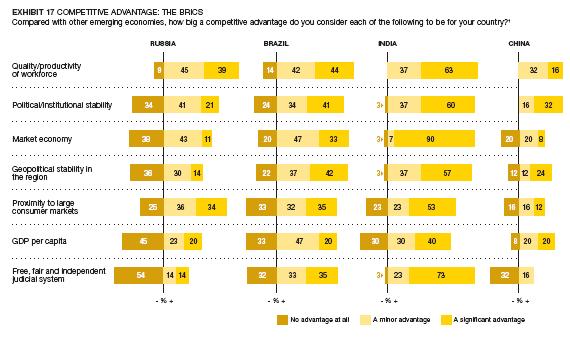
PWC Global’s ninth annual global CEO survey focuses on CEOs’ attitudes about the so-called BRICs economies: Brazil, Russia, India and China. These economies are poised to experience explosive growth over the next several decades, and the survey finds that they are increasingly the focus of CEOs’ globalisation efforts as well. The thing to note is that in addition, companies based in these economies are not just globalisation targets of richer companies; they are full participants in the globalisation boom and share in the positive attitude about globalisation. Overwhelmingly, the CEOs we surveyed reject the notion that they are globalising primarily to cut costs. The CEO’s are pursuing globalisation to access new customers and markets.This has positive implications for all companies regardless of industry, geography or income.It also has positive implications for consumers all over the world; they will be able to choose the best products and services at the best price regardless of the origin of the product/service. In the report you can see how Dr. Li Lihui CEO, Bank of China sees the economic maturity levels of china wanting – as he sees it, “From the perspective of a Chinese bank, he does not believe that the Chinese economy has yet become mature in most market sectors, although good progress has been made”. He points out,” For both commercial enterprises and banks, globalisation is bringing about more market opportunities, regardless of types of products, client resources or regions. At the same time, besides the capability to uplift lives of billion, globalisation does bring with it the potential for adverse effects on developing economies such as China. In particular, certain industries and enterprises with high relative costs may be the first to suffer”. Do not miss to read Satyam’s Ramalinga Raju’s view that Indian companies have now begun winning large deals and to that extent the global majors and the Indian companies are now on the same playing field and playing the same game. Companies that have depth of leadership, are innovative and can partner well with clients will have the competitive advantage and the origin and lineage may not matter beyind a certain level. These are going to be the differentiators. He adds that terms like offshoring will be passé, as those who do not have this model will not be in business & the growth prospects will be limited only by the ability of enterprises to change fast enough to exploit the emerging opportunities that will be ushered in on account of the technological breakthroughs. There are other interesting CEO perspectives included in the report. The confidence level shown by the emerging economies & leading business originating from therein are indeed impressive. A fortune article finds that despite latent weaknesses, in the three countries - Brazil, India, and China - it is globalization that is driving development and expansion. Russia’s GDP surge, on the other hand, is based on high oil prices, rather than economic growth and goes on to say, “One reason the BRIC idea resonated is that the term itself evokes building blocks, foundations, solidity. But a closer look at the political and economic peculiarities of the states in question suggests that BIC, not BRIC, is the better formula. Call them the BIC - "breakout industrializing countries." Russia is quite out of place with that crowd”.Clearly in this changing world, even the predicted change undergoes change midway through!!
Last month, I covered on the topic of enterprise analytics. I also pointed out therein, the happening covered earlier here.Tom Davenport wrote in Jan issue of HBR an article titled competing on analytics. BAM, BI, CEP, analytics: whatever it might be – it is clearly making waves. We are seeing that industry after industry is beginning to heavily invest in enterprise data analytics. At a time when firms in many industries offer similar products and use comparable technologies, business processes are among the last remaining points of differentiation. And analytics competitors wring every last drop of value from those processes. Some companies have built their very businesses on their ability to collect, analyze, and act on data. I also wrote therein, while competing on analytics means competing on technology, these forward looking organizations apply technology - with a mixture of brute force and finesse - to multiple business problems, while directing their energies toward finding the right focus, building the right culture, and hiring the right people to make optimal use of the data they constantly churn. In the end, concludes Tom very rightly so, that people and strategy, as much as information technology, give such organizations strength. Most companies in most industries have excellent reasons to pursue strategies shaped by analytics.
Courtesy of Vinnie came across this followup article by Tom Davenport wherein he finds that a majority of companies pursuing optimization have failed to deliver the analytical capabilities necessary to make their strategies succeed. Most BI implementations have been Although typically marginal to the success of the business and are managed at the departmental level & in general these tools are invisible to senior executives, customers, and shareholders, and they don't propel the competitive strategy. Pointing out that a few businesses within financial services—particularly financial-investment and trading firms—have competed on analytics for decades, he sees the spread of analytical competition enterprisewide, to companies in a variety of other industries—including consumer finance, retail, and travel and entertainment. He reasons out for such organizations, analytics are becoming a primary competitive weapon. They use analytical tools to change the game, or to perform substantially better in the existing one. As Geoffrey Moore points out, business analytics needs to close the loop from generating the insights to using them to drive operating procedures that can systematically capitalize upon them in time and at scale has been the exception rather than the rule.When the exception happens, the results are transforming. But for the most part we see a landscape of intermittent connections, flashes of insight, but no systemic gain. He is on the mark in pointing out that most of the business analytics engagements inside enterprises represent a highly evolved form of corporate entertainment. Its core practitioners generate insights without accountability. They communicate those insights to business managers, who do have accountability and who are moved to act, but who are unable to do so in time.
Tom now identifies 5 stages in enterprise adoption of Business Analytics ranging from Stage 1 companies facing major barriers for implementation of analytics to Stage 5 companies that have embarked upon analytical competition as their primary dimension of strategy. He goes on to point to 11 of the 35 companies that he says he looked closely for assessing success of analytics initiatives : Apex Management Group, a health-care actuarial firm; Barclays Consumer Finance; Capital One; Harrah's; Marriott; Owens & Minor; Progressive; Wal-Mart; an unnamed consumer-products company; and two sports teams, the Boston Red Sox and the New England Patriots. Exhibiting all the attributes of analytical competitors he emphasises, these businesses are highly successful within their industries and attribute their good fortune at least in part to their analytical strategies. Barclays, for example, says its analytically oriented information-based customer management strategy let it increase revenue per active account by 25% while reducing delinquent accounts by 23%. He notes that these Stage 5 companies are committed to their analytical strategies from the bottom up, even to the level of the CEO. As the analytics industry is a mega segment and a fast growing one at that( repeated surveys show this as a high priority spend area for enterprises), and a very important technology that could be used for competitive differentiation by business , focus and research like this with linkages established to business results are highly encouraging. As consulting is all about delivered value, I strongly recommend more and more of such studies and results to be circualted and studied as the investments in IT keep increasing and Business demanding better and better returns out of such investments.
I just finished speaking to a friend, who had barely finished listening to C.K.Prahalad speak in an internal meet today - he said CKP’s thrust of the discussion today was Innovation. We recently covered Gary Hamel writing in the latest issue of HBR, on management innovation that can create long-lasting advantage when it meets at least one of three conditions: - It is based on a novel principle that challenges the orthodoxy; - Iit is systemic, involving a range of processes and methods; or - It is part of a program of invention, where progress compounds over time
Geoffrey Moore recently wrote "The more established your company, the less likely it is a type for you to specialize in. Alternatives include application innovation, product innovation, platform innovation, line extension innovation, design innovation, marketing innovation, experiential innovation, value engineering innovation, integration innovation, process innovation, value migration innovation, and acquisition innovation. This last one, in particular, is usually an established enterprise's best bet for dealing with disruption"
Courtesy of Innovation Insider came across this excellent piece by Subroto Bagchi titled Different Layers Of Innovation. Subroto, a brilliant writer on management topics, starts by postulating that with inclusive view of things the mind leaps forth with neither ideas that nest neither in the present nor the past.Inclusion is about feelings for people and situations that are twice removed from us.When we can build an idea that makes a difference to people and situations twice removed from where we stand, it is bound to be innovative. He points out the serving immediate customer’s better can be served by creating a linear extension of your offering to serve them better, it is not necessary to create something innovative. Some thing “new and improved”, something that is “renovated” is good enough. On the other hand, if you wanted to make a tangible difference to your customer’s customer or your supplier’s supplier, it would call for innovative thinking. Only such thinking creates competitive advantage by expanding the sphere of influence. To be able to bring people who are twice removed into the fold of your beneficial impact, you have to think inclusively. Inclusion as an act leads to connecting with people, their needs, their thoughts and their desires at an existential level. It is at that level that the quality of human thought is at its creative best.
Only that quality of thought leads to products, services and processes that provide new and disproportionate value. Innovation stems from converting knowledge into something valuable. According to INSEAD’s Yves Doz, we relate to knowledge at three different levels: - At the lowest level, we relate to knowledge in a technical context. At this level, knowledge is about specifications handed out to engineers who need to create something out of it. This constitutes a layer of knowledge, which can be called adaptive.
- At the next higher level rests the intermediate layer known as the experiential layer of knowledge. This level is not about technical specifications and functionality - it is about getting into the shoes of the end-user. Eg – Nissan designing the car suited for European markets.
- Beyond this level is what Doz calls the existential layer, in which knowledge is not about getting into the shoes of the customer but, rather, about the ability to “creep into the minds” of customers. When Sony designed the Walkman, it was operating at this level.
Pointing out that each of the three levels is separated by a glass ceiling, he highlights that the movement across these layers do not happen as a natural process and value in each layer is created from how we relate to a given body of knowledge. Innovation is possible at each level, but breathtaking, discontinuous and memorable innovation takes place only when we are able to think at the highest level. I wish all the high growth service companies focussing on plain operational efficiencies and centering on technology adaptations focus on such things. A distinguished colleague of mine said that the present management of HP, while may seen to operationally delivering well,may actually cut at the bedrock of HP's long term success by not adequately trying out new innovative things. An innovation related metric for all the promising companies are a must focus factor.
Courtesy of Pito Salas saw this image. As he explains, while the image looks like it's moving, it doesn't in reality - matter of fact it is not an animation at all. He explains that It's your brain that getting its circuits scrambled. Proof - Just cover most of the image with your hands and look at a small part. It doesn't move. Amusing!
C. K. Prahalad earned the third spot on Suntop Media's 2005 "Thinkers 50" list, just behind Michael Porter, and Bill Gates. He has recently spoken about the Indian miracle in a variety of contexts.More than others, CKP knows what he is talking about in the context of India - partly because he was born there- he also sits on the board of Hindustan Lever Limited, top amongst India's corporate icons.
As CKP sees it, in the last ten years, India has done three things very well. - It has built some global capabilities, first locally and then leveraging it globally. That is where you find the IT industry, the pharmaceutical industry, the automobile components industry, the diamond cutting industry, and so on. - Second, it has created an extremely high level of aspiration for both the poor and the rich. The rich and the educated can aspire to be world class, and the poor can aspire to have an education for their children to allow them to escape poverty. - And the third thing is that the government fundamentally accepts, even though it's very hard to implement, that India has to become an integral part of global trade. He adss, those three are going to put India on the right trajectory. He has some added insights as to why he views indian success as not owing out of mere cost arbitarge : India has built extremely high levels of quality. TQM is an integral part of software development. There are new methodologies and tools, and innovation in work processes and in the tools themselves. This adds up to four or five layers of advantage, including speed, worldwide project management, common platforms around the world, and expatriate management. To continue to believe that cost is the only building block misses the point(Thats why I laugh when people say Africa can give services at $5 and the indian run would be over - ignorance at its best). He goes on to believe that India will invent a different kind of manufacturing - very high quality, design-centred and software embedded.It is more you design, you develop, you manufacture, you ship. It is still in its infancy, but I expect it to grow as rapidly as the software side. He is expecting that Indian companies would be sharpening their competitive skills, demonstrating world class quality, becoming very profitable, building market cap, and using it as currency to make acquisitions, and expand rapidly overseas and predicts 20 to 25 companies in the next two to three years spreading their wings and getting out of India. He says that China and India will be the second and the third largest economies next to the United States certainly by 2015. Also he brings forth the point that India is the place where cutting-edge problems as well as opportunities lie.Given the large number of small firms operating on a global scale, Indian experience can challenge some assumptions about the prerequisites for globalization. Good thoughts- definitely to be noted by all interested.
India is certainly in the centerstage of attention as the recently concluded - World Economic Forum annual meet and Nasscom meets showed. If you can't beat 'em, join 'em and figure out how to take advantage of it - That says the Indiana Business Journal reporter summarising the sentiment of venture capitalists like Hoosier's attitude towars investing in India and India based firms. As the visiting investors see it, India after decades of tepid growth under the shelter of a formerly protectionist government, is now starting to embrace entrepreneurship.Some investors believe India's own high-tech startups are finally ripe to produce explosive returns.American executives are drawn to India by the chance to locate business functions in a nation whose talent is reliable and cheap, whose commercial laws are based on British tradition, and whose business language is the queen's English.India's biggest question marks remain its marginal infrastructure and its lack of reliable middle management.India has clear advantages over China, its main competitor. There, U.S. executives have to bridge a language barrier. And in China, intellectual property protections are spotty. That's critical when a company is writing proprietary software or researching new drugs. David Kerr, part of the Indian contingent finds that in the next two decades, incomes will begin to rise and India will create another market the size of the U.S, and highlights the need to establish in a market in the nascent stages of its emergence, as it creates incredible opportunities. The current state is that silicon valley venture capitalists want to do deals in the millions. As the group sees it, most Indian entrepreneurs aren't ready for that. They need investments in the thousands. (Am not sure about this - I can point to a few seeking early stage angel investments running into millions). The visting group while noticing infrastructural probelms, also notes the ethos of circumventing such difficulties to carry on. While some investments are beginning to happen, the ground reality very much echoes what we covered earlier here. Vast majority of venture money tends to go into existing and later-stage businesses. There is little or no real VC money available in India. Companies that are receiving money in India are either spin outs from existing large businesses, captive units or second tier outsourcing providers that may lack the size or scale to compete with IT service giants and want the private equity money to grow through rollup and acquisitions. In the US, venture money goes into early stage, pre-product or pre-revenue companies , while in India, a majority of the private equity is going into late stage businesses. A friend upon seeing this post asked me when to expect the likes of next Google to come out of India. I had no answer to provide. Truth is that in general most indian enterprises are hardly innovation chasing entities, and the framework for VC entry & exits are poorly defined. Coupled with limited VC activity in the past and archaic regulations – these make it a tougher breeding ground for enterprises like that of what is seen in the valley. Red Herring writes that early-stage funding in India has been the bane of would-be entrepreneurs, with starry-eyed young men and women rejoining the ranks of the employed after failing to raise any capital. The recent economic boom in India has resulted in increased entrepreneurial opportunities for people with new, innovative product ideas, or disruptive business and delivery models. It’s a climate where startups are springing up in every area. The fear is they will die if they are not supported early enough. For all the interest, mindshare, the actual venture flow is pretty limited into the system, while interests in investing are clearly multiplying. Seen from an indian perspective, the talent levels inside India continue to be very high – all it requires is a vibrant ecosystem - but not many recognise the issue there - talking india's growth for granted may be the biggest mistake - the country can't afford it. I also want to point out that without an effective, continual presence in India the VC's and angel investors themselves would be running the risk of shooting themselves on the foot - while visits can give a flavour, its realtime presence that could help appreciate things better and adapt - for both sides. Also the world needs to understand that Bangalore is not the be-all & end-all of Indian IT.Too many US investors think that there are only set ways of doing business - their way - NO, doing business in Asia is different - the call is to recognise this and take appropriate steps. The recently concluded Nasscom leadership summit unfortunatley did not provide the focus needed at that level - hopefully other would - thats what the Indian experiment has shown thus far - success emerges from the edges of the instituition.
John Hagel provides some excellent perspective post WEF meet @ Davos on integration and jobs. Commenting on the general call for integrating more, he points out that boundaries are healthy – he goes on to call them as the catalyst for innovation. Boundaries help bring forth different experiences and perspectives to bring to bear on the issues confronting us & he calls for more boundaries and more friction across boundaries. Constructive friction whereby we need to have more respect and willingness to engage constructively across boundaries would become a source of great richness. He also brings forth the point that the western world ought not to be concerned about jobs, but the more fundamental issue is talent development. If people don’t develop appropriate talent and don’t continue to refresh that talent, there will be no sustainable jobs and certainly few, if any, high value jobs. Reframing the issue as talent development also highlights the increasing importance of talent as a source of comparative advantage in global markets. Asking not to confuse talent development with education, he highlights that education is becoming more marginal as the bulk of talent development occurs outside of traditional educational institutions. This echoes Mark Twain’s famous statement ,” I have never allowed my schooling to interfere with my education”. He is on the dot when he points out that talent development is a continuing process and not confined to one stage of life, we will have to broaden our view of the institutional platforms required for talent development. All public policies - from immigration policy to intellectual property rights should be assessed through this lens.
CERN announces the successful completion of major milestone in the ambitious grid project that it is pursuing. A huge 100,000-PC grid-computing network being built to help research the origin of the universe passed the third of four major tests recently when it reached a data-transfer milestone, with up to 1GB/sec. of physics data sent over the global grid. The data was transferred from CERN in Geneva to 12 major computer centers around the globe. More than 20 computing facilities at universities and colleges were also used in the testing. The data transfers were made to analyze real-time storage, distribution and analysis of the data while the grid is being built and refined. The completion of this service challenge is a key milestone on the way to establishing the necessary computing infrastructure for the Large Hadron Collider(LHC), the world’s largest scientific instrument. The results represent a significant step forward compared to a previous service challenge in early 2005 that had involved just seven centres in Europe and the USA, and achieved sustained rates of 600 megabytes per second. The grid will also be able to store some 15 petabytes of data - 15 million gigabytes annually to start with , and will have to be continually expanded because the data will have to be continuously preserved for analysis and that’s why the need for distributed storage becomes critical. Planetgrid should be in a position to store and process data that it thousand times more than the volume of printed material indexed by Library of congress. This is an important experiment wherein some 150 universities and research labs worldwide will be connected to this system, all providing some degree of processing capability.The grid is expected to go live next year. With a successful completion of this such facilities/services could appear in the other sectors. Like the internet moving from academia to industry creating huge impact, this could also create a large impact in the technology world. Grid computing is beginning to see action at the enterprise level as well- besides applications in molecular research. Recognizing this various technology vendors are beginning to make moves. EMC acquiring software/ partnering with acxiom to offer hosted grid storage services and eventually help users build out more scalable and flexible grid-based storage. With EMC owning VmWare and with Globus alliance putting efforts behind combining grid and virtualization technologies, growth opportunities increase several times. Recently, ClearCube Technology and DataSynapse have partnered to deliver a grid-enabled PC blade platform. The companies claim the hardware and software combination is the first of its kind for the financial services and insurance industry. Financial services and insurance firms have been among the leading adopters of computing grids to run complex portfolio analysis, capital reserve, risk assessment and actuarial models, a market DataSynapse has been dominant in. By combining DataSynapse's GridServer software with ClearCube's PC Blade platform, financial enterprises will have a grid computing solution that provides greater performance, efficiency and scalability. Enterprise software shall also get influenced/affected by the advances in grid technologies.Grid technologies are showing strong signs of being a game changer in the technology industry..
Jeff Veen,one of the well known faces of adaptive path joins Google after measuremap got acquired recently. Measuremap analytics was launched with the aim of bringing power of web analytics to help bloggers feel that same sense of connection with their audience. Measuremap may end up complementing Google analytics, one of the poular services that Google launched recently. Jesse James Garret of adapativepath wrote about AJAX almost an year back. Sensing the impact that this could make to the web world, I blogged about it on Feb22, 2005, as soon as it was published. Much of the web2.0 progress can be related to this as well. Peter Merholtz writes about Jeff Veen’s departure and measuremap sellout. Jeff has always been very popular and am tracking his works from early dotcom days –during his days at Lycos, Wired etc. He is a real force to watch – here’s wishing him well and Google has undoubtedly got a good product and good talent – Now its time for Google to make blogger perform well. The way blogger is having issues – Google would soon catch up with Microsoft - in providing questionable degree of stable services/support.
Daniel Gross writes that the good folks in the West are generally happy to sell real estate to nouveau riche Arabs and Asians - as they pay top dollar. In 2004, Lakshmi Mittal, the acquisitive Indian steel baron, dished out $128 million for a residence in London. (And few of the bienpensant clucked when Mittal rented out Versailles for his daughter's wedding.) Afterall Mittal is the third richest man in the world behind Bill Gates & Warren Buffett. But when the purchase involves a corporation that produces an essential industrial product, that we-are-the-world comity disappears. When Mittal announced a hostile bid for Luxembourg-based steel company Arcelor, the French and Luxembourgians (Luxembourgeoisie?) have reacted harshly. Arcelor's board rejected Mittal's offer as unacceptable in every way. Arcelor's Runyonesque CEO, Guy Dolle, has sniffed that his steel is "perfume" while Mittal's product is like "eau de cologne." Thierry Breton, France's finance minister, fretted over the potential clash of civilizations that would ensue if Mittal were to emerge victorious. This prejudice is misplaced, even stupid. The consolidators emerging out of India, the Middle East, and Latin America are far more cosmopolitan and savvy than their European and American counterparts. The managers and entrepreneurs behind companies like Mittal, or Mexico's cement giant Cemex, or Egypt's Orascom, are the best and brightest those countries have to offer. They are buying companies run by Europeans and Americans who are, in many cases, certainly not the best and the brightest. Otherwise, their firms wouldn't be in such poor shape that they might need a foreign bailout. But it should not be lost sight that Mittal Steel is headquartered in Rotterdam and managed out of London. This takeover battle is, therefore, entirely a European affair. Times are changing – the sooner society realizes, it is better for all. Update :Arcelor has since stated that it would consider a cash offer.
I recently covered the perspective,Web 2.0is not about specific technologies, but more to do with new ways of exploiting what can be done over the net. A great way to get a feel for web 2.0 is to look at new geographic applications such as Google Earth, Google Maps, and Microsoft's Virtual Earth. They bring together cartography, aerial photography and internet search to create a compelling answer to the question "where?" Web 2.0 sites are portal-friendly, easy to aggregate and easy to link to. This is where representational state transfer (Rest) architecture is valuable - the idea that even on a dynamic site everything should be URL-addressable. If a site has an API or even just an RSS feed, someone is thinking on the right lines, especially if it is useful for mobile devices as well as the desktop. Another characteristic is simplicity. Web 2.0 sites do everything to accommodate the user. Web 2.0 is about conversation, which is not just a feedback form, but new ways of interacting with users. Calling for a reality check, I wrote that moving forward like in the e-business space, we need to have the wisdom and mechanisms for cross-integrating/leveraging web 2.0 applications for larger benefits – this calls for standards in development, build & integration blocks – all this would come only out of a solid base of web 2.0 apps that get built beneath – truly a tall order given the fragile nature of several web2.0 entities. We can definitely see a petering out of the web 2.0 momentum as we see it now and several entities would disappear – but one hope is that out of this something robust and strong might emerge – but we have cut through the hype Zoli Erdos blogs about the recently held panel discussion titled,"Web 2.0 in the Enterprise" and shares the conclusion from the panel. • Web 2.0 is people, collaboration, creating together. • Business Model change is more important than technology change. • The divider between consumer and enterprise software will blur. • Give up control, gain value. • Start small, grow bottom up. • The question is not what new programs can do for us, but now that we're enabled, what do we do together, better I am still not too sold on web2.0 becoming an integral part of enterprise software or business activities. I particularly like Jeff Nolan’s response on how to absorb Web 2.0 inside the enterprise –when he says that history is against us, few companies make the transition. But rules exist to break them :-) Today's vendors invest hugely in technology & points to the story by Shai Agassi : CTO of Prcoter & Gamble told him if the SAP system goes down for 4 hours, it takes out the quarterly profit. His observation that Oracle is buying its own LAMP stack & they can only beat SAP by changing the game : removing licence revenue entirely & that it can be argued that Oracle and SAP are already in the subscription business: maintenance revenue , deserves serious consideration. On a related note see my recent note, time to relook at software maintenance models and revenue stream.
Chad Dickerson writes about how big company managers routinely describe themselves as either “tactical” or “strategic.” The strategy camp may look down on the tactical camp and vice versa. Chad finds Marc Hedlund’s post about Web 2.0 development practices confirm this view: More often, though, the developers and the CEO respond to the majority of the support email. CEO's openly say that they respond to about 80% of all the mail they receive. How better to know what people are saying about your product? he asked. “Strategies” are big and sweeping and inherently pass the task of implementation to someone else. Tactics are inherently all about executing. I particularly liked this one from Chad - The distance between “strategic” and “tactical” is measured in meetings, PowerPoints, conference calls, and, well, “not writing code.” Listen to analyst calls/read transcripts – you can see this in action. Limiting (or even mostly eliminating) that distance is the key to making things happen. Emphasizing that strategy directly combined with tactical skill is the real killer combo. “Strategy” in the absence of tactical engagement is a loser’s game and concludes that the tactical is the strategic today. Scott Gatz has the right approach - winning companies have always recognized that there is a need for combination of both. When a company doesn’t get it - that values tactical execution over strategy OR values those people who talk strategy but want others to “do the dirty work” - then it is likely that the company is headed for trouble in today’s competitive world. In my view the ability to zoom in and out makes the difference – the question of one in place of other does not hold good where the cycle time for every possible type of enterprise activity is drastically coming down. Its like the Yin and the Yang – Think & Do etc. While being action oriented may make everyone feel busy – too often without a strategic intent , too much of activities may get mistaken for achievements. I also believe that both feed upon each other. Wherever theloop gets closed in realtime/very fast, the results are better. But in general I have seen across industries,that organizations with better strategic engines and good to average execution mechanisms clearly outperforming organisations with average strategic edge with even superior execution engines - such organisations generally degenerate into serving commoditized segments -its another matter that they may do well there -thats till the next wave come and engulfs the space. I think the size of the enteprise matters a lot here. In large enterprises where planning horizons are longer, we can see the emphasis of strategy & planning more pronounced. Large enterprises may get buffeted between annual budgets and targets – incapacitating them to take quick big and bold decisions. Some large enterprises run the risk of calendared into decisions when markets can move faster- case in point look at the acquisition & consolidation binge in the enterprise software industry and it may not be good for consulting companies to wait for annual meets to finalise strategies for improving market share/consolidating strengths.
Sadagopan's Weblog on Emerging Technologies, Trends,Thoughts, Ideas & Cyberworld "All views expressed are my personal views are not related in any way to my employer"