The spirit of dynamism and enterprise combined with daringness and thinking big makes stories like this very interesting to read. I particularly like this line –“if you want to be big, you have to dream big. You can run a small company and be happy. An entrepreneur doesn't have to always own a big company”. Recently I was speaking to someone wanting to start something new – he echoed similar views. The Indian ethos is changing for sure. As I wrote recently, while the ecosystem inside India is also tough where job market dynamics at senior levels are less active compared to what we see in the western markets. The talent levels inside India continue to be very high – all it requires is a vibrant ecosystem - but not many recognize the issue here - talking india's growth for granted may be the biggest mistake - the country can't afford it. With all this , without doubt one hears in India- waves and waves of ideas for entrepreneurial moves in the tech arena – the spark, the ecosystem and the combination. The Indian market shows propensity ot consume a lot many things. Entrepreneurs can spot many business opportunities therein as well. End of the day, its ideas, innovation, scale & speed of execution that matters more.
For many including yours truly, IBM ThinkPad is the preferred laptop. For business people, IBM ThinkPads have been the gold-standard for laptop reliability, performance, and durability. Geeks may express a preference for other hot shot brands. In the Lenovo world, I must agree that ThinkPad is maintaining its brand name through new rollouts – in fact the transition towards Lenovo appeared almost to be faultless.
It is quite gratifying to see that Lenovo is seriously working on new designs for the future – Look at this impressive post on the design of the Lenovo 3000.
I particularly liked the set of observations made on the design of the ThinkPad
“ThinkPad for example is a simple black box when closed. The Lenovo 3000 series also has a unique profile and unified form when closed. Many competitors notebooks appear to have been designed in a very different way. It seems like the display department designs the top, the CPU department designs the bottom, and they meet for the first time in the hinge department. Can you imagine designing a car like this? It would be a disjointed mess”.
Lenovo 3000 seems to have married ThinkPad quality & sleek design and is all set to be well received in the marketplace.
The Hindu Business Line has some interesting excerpts from a conversation with Revathi Kasturi, managing director, West Asia SUSE Linux. Novell recently launched SUSE Linux Desktop in addition to being quite active in terms of expanding the reach of their global Linux initiatives. Generally speaking, there’s an impression in the western world that emerging markets would adopt open source solutions faster on account of several factors – being cheaper and first time adoption possibilities count amongst others as key factors. The interview highlights amongst other things key issues around the entire open source industry: - Subscription based software model, leading to Software as a Service (SaaS) model. - The shift in adoption of Linux movement from Geeks towards Linux for the enterprise. She asserts that the availability of commercial Linux — enterprise class Linux with commercially available support — is critical to adoption. Her claim that a single piece of source code compiles for seven different hardware applications and the revenue model from a license perspective and turns it into a services revenue model looks interesting. Look at Kim Polese perspective on the support model for open source companies. - Her perspectives about the revenue stream growth of Linux in the emerging markets and I liked her positioning of not equating open source with free but as a credible alternative. One of the often repeated comments from CIO's is that while working with [commercial software], there are pretty standard diagnostic methods to use when things don't work. [But] Open source isn't going to give solution to every problem as it doesn't control the core development of Linux & so the teams have to be far better technically and in their problem-solving skills. This may have a certain impact on costs and thats where I think the 20% drop in support renewals looks insightful. Earlier, I wrote that the contours of what need to be done to support open source components is getting clearer and a not seeing several players in the opensource world thinking along these lines – it would be a major impediment to consider adoption of opensource in enterprises if the support model is not made widely available and the economics and technology upgrade rate demonstrated as beneficial. Major players like Teradata supporting Linux platform is indeed a significant development. Some things are showing signs of improvement but the adoption threshold needs to be crossed faster – with so much delay in Vista rollout happening, here’s the time for these enterprises to muscle in.
Just read that Accenture’s market capital is now less than Infosys and Tata Consultancy Services. Both Infy and TCS have market caps exceeding Rs 100,000 crore or around $22bn. That’s around 30% more than Accenture. The growth rate and the related P/E ratio makes the difference. Look at this - corporations outsourcing critical work would begin to feel lot more comfortable in evaluating vendors that are growing and stable and offer comparable services at more economical levels- gives them more choices.
Vinnie points to the new refurbished Ingres. Terry Garnett, Chairman of re-born, repositioned Ingres is happier with much lower margins than what Oracle is used to – buying 80% stake at 35 million US$ where sales is at 50 million US$. While Larry believes that Ingres for a long time has suffered form underinvestment, Terry has hired ex-Oracle alumni and the COO Roger, comes from Wall street background. Potentially at stake - 59% of oracle’s nearly 8 +plus billion database sale. Users - particularly those looking for database solutions for high value transactions now have a choice to look at industry strength database infrastructure that can be bought at lower prices.
Dynamism in the tech sector actually helps users - thats real. Gone are the days of uncontested sales and more choices abound.
Pew has released a study report after surveying around 250 leading internet stakeholders on the future of the internet.
Amongst the key expectations for the Year 2020 include:
• A global, low-cost network thrives:
• English displaces other languages:
• Autonomous technology is a problem:
• Transparency builds a better world, even at the expense of privacy:
• Virtual reality is a drain for some:
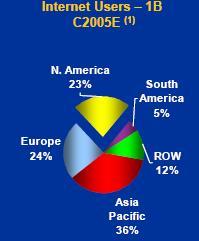
• The internet opens worldwide access to success: While all these things display optimism, they are also more or less obvious, the report would have been more meaningful if it had looked at expectations and developments from Asia. Afterall, studies show that 36% of Internet users are now in Asia and 24% are in Europe. Only 23% of users are in North America and Asia would be adding more internet subscribers in the days to come. The impact of wireless, next generation communication hubs, politics surrounding Ipv6, Icann, explosion of content in asian languages- all these need to be factored in while discussing the future of internet. The rise of technologies like semantic web and lack of discussion about social networks, user generated content etc make this an incomplete work. Sadly the report falls short on various counts and may need to substantially increase its coverage, depth and probe advances in multiple dimensions in its next release.
Tom Coates presentation in the future of the web apps conference makes fantastic reading. Months back I referred to his earlier presentation. Tom’s expression is simply at its best here. The theme here is about how to generate systems and models wherein large groups of people can publically create something together that's more than the sum of its parts. It talks about motives for social engagement, how to derive value from innumerable small contributions and what challenges this form of creation may be causing in a world of proprietary data. He shows the ways in which social software can be used to build aggregate value. Pointing out that
• An individual should get value from their contribution • These contributions should provide value to their peers as well • The organisation that hosts the service should derive aggregate value and be able to expose this back to the users
The thrust of the presentation is that social software brings with it the ability to weave : • Individual Motives (Personal Adoption) • Social Value (Social Networks) • usiness /Organisational value (Markets/Segments)
These are accomplished by capturing many voices with emergent order (polyphonic), in the process generating lots of comprehensible material resulting in opening up social value. This, goes the argument is achieved by providing people a place to represent themselves, allowing them to associate, connect and form relationships with one another, help them annotate, rate and comment and broadly look for ways to expose this data back onto the site.
While, I am not a great fan of Web 2.0 applications, but increasingly I see that this is slowly emerging as an important space( that is if you cut all the hype) where lot of creative energy is getting channelised and the potential for growth here is indeed high(particularly those centered around social networks)and as such these developments need to be watched more closely.
The automobile industry, once hailed as the mother of all industries is something that few people can choose to overlook in a global scan.As I read this, I just can’t refrain from referring to Seth Godin note on Ford. While the consolidation Buzz was always there for several years, I do read about and see the aggressive expansion plans of Toyota, Hyundai, Honda and the likes around the world. These people besides competing with Detroit are investing heavily in emerging markets where the US carmakers are not lagging far behind. No comong to Seth, he writes,
A couple of decades ago, Ford had everything. Cash, brand, distribution, political influence, a trained workforce... Then, through nothing but management hubris and arrogance, they destroyed the company. At just about every turn the company ignored the market, alienated their workforce, distanced themselves from their distribution network, vilified their customers and chose short-term expediency ahead of long-term change. They lobbied to keep gas mileage standards high (doing the opposite would have increased the market for cars). They lobbied to keep SUVs unregulated (and got addicted to a short-term high-profit alternative to cars) and they bought remarkable brands and made them average. There were hard things they could have chosen to do, things that would have meant change. There were short-term hardships they could have endured to fix their dealer network or reinvent the way they designed and built cars. Instead, they stayed inside the Detroit beltway, played the car game, managed the stock price and paid themselves a fortune.
Lovely words from Seth – what’s true for Ford is true for several corporates around the world across industries – so when he says Monday, when you sit down with your organization to plan the next decade, perhaps you could ask, "what would the top people at Ford do?" and then do precisely the opposite, it carries lot of sense. It’s clear to me that the Asian manufacturers are not in a position to ignore Detroit. A few months back, I was meeting a senior Japanese auto executive, when I casually mentioned over lunch that his and other firms may be actually making the US automakers go down fast – the feisty, aggressive, business savvy executive told me, “NO” and said they won’t disappear – he chose not to elaborate further, but appeared quite convinced about his view. The hope is good brand value, cash at hand and a new proven CEO can make things look better. Proposals like this may help as well.
The Fortune cover story on Google talks about the structured chaos fostering the growth story for Google. Google is generating more than $800 million in cash each quarter. In the process, Google is thrashing the competition - in market share, deals won, buzz - notably Yahoo and Microsoft. It's also cozying up to a growing list of heavyweights you'd think would be warier, including News Corp, Viacom and ad-agency giant WPP. Along with Googleyness, chaos is among the most important aspects of Google's self-image. CEO Schmidt acknowledges that sometimes promising new products are buried so deep within Google's sites that users can't find them – even No.1 google supporter can’t remember them all at once. Google has released at least 83 full-fledged and test-stage products - none has altered the Web landscape the way Google.com did. Additions like the photo site Picasa, Google Finance, and Google Blog Search belie Google's ardent claim that it doesn't do me-too products. Often new services lack a stunningly obvious feature. With so many moving parts, it's natural to wonder if Google is truly a company for the ages and investors are concerned if Google can come up with a second act. There's nothing to suggest that its growth engine - ad-supported search - is in trouble. But it's clear from Google's tentative lurches into new forms of advertising and its spaghetti method of product development that the company is searching for ways to grow beyond that well-run core.
I have been writing for some time along these lines -look at the note on drilling good sense into google pricing. In a related note, I covered, while assessing non-search services & developer services one finds that Google does innovate in some spaces but has largely innovated in order to gain entry in markets that already existed. While google breathes innovation, competitors are generally quick to notice and are catching up its high time Google clearly explains its vision that it is executing for the next 2-3 years – very important that there should be a plan to grow and sustain the 120+Billion USD marketcap (incidentally bigger than the GDP of some oil producing Asian nations – the likes of Indonesia.) contrarian views about Google’s valuations definitely need a closer examination. I think this issue needs some serious evaluation as I had been pointing out for sometime like here, here about google's ability to sustain its leadership and support the very high marketcap. Google has to come out in the open about its plans for spending the money say building its own Internet, online index,along with monetizing models in more specific terms. True - some of google recent launches like Google Earth, Google Checkut may provide more monetizing opportunity - but where's the marketing and communication on those lines. I hardly see them. Its time that we get to see and know things beyond the likes of generic macro views like that of George Colony, which focuses only on what and not the how. Like in any other industry the responsibility of pioneers and leaders are lot more than just looking after themselves - they are trendsetters and role models in the industry.
Tim Matlack of Wipro thinks that the visibility of Indian headquartered companies offering consulting services has increased quite a lot in the recent years. He thinks that one of the reasons that these companies have been successful is because of the commitment they all made to embedding quality processes in the company and running as very, very, centrally disciplined organizations – done both cultural & defensive reasons. Centralization of business planning and business controls helped them impose a certain amount of discipline and rigor, in the process making them very strong. In many cases, it contrasts with the more decentralized kinds of historically partner-based firms where, unfortunately, in the worst examples it was pretty much whatever the particular local partner wanted to do that got done. Three decades back even firms like McKinsey, which in general are among the best-run consulting firms in the world, would tell potential candidates, “Well, you know, LA is this style of operation. It’s a bunch of ex-military guys, and they run it in their own little fiefdoms. And then there’s Chicago, which operates this way. And then nobody goes to Germany who’s a woman, because the Germans don’t like women.” Firms just were that way. And that’s a legacy that still kind of lurks in the background, which is not the case with Indian headquartered firms. In an interview with full of insights he identifies that one of the things being planned within his organization is to develop consulting solutions capable of leveraging offshore talent to a greater degree. His assessment of the business model of other players may be debatable, but nonetheless, it is quite interesting to see his perspective on entering new arenas of consulting, integrating with the larger team and the model for scaling up.
As I see it, one experience for customers is something that was supposed to be unified through methodologies but in consulting too often than not, one sees that the personality and regional traits dominate and so this is yet another innovation that Indian headquartered companies are bringing out. As I wrote earlier, like the seven wonders of the world slowly giving way to the new seven wonders of the world, there is no doubt that the consulting, systems integration and professional services market is changing. A glorious era lay ahead for offshore consulting firms - and in this flat world where one is headquartered may not matter at all..
After all, consulting is about delivered value and it is part of the solution -to-the solution conundrum. All these are happening while the traditional big consulting firms are happy featuring golfers! I also firmly beleive that the offshore headquartered firms need to aggressively invest and build scale to capitalise on this space as well. Natural advatages and incumbent inertia can give a lead only upto a point - only proactve moves could lead to sustained growth.
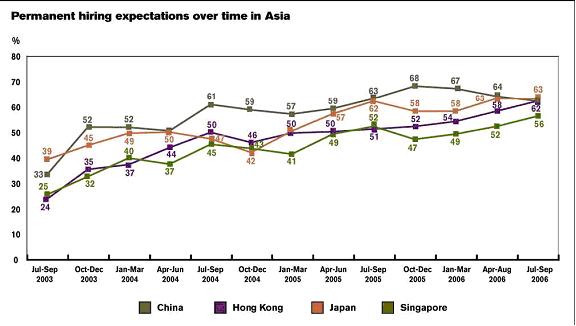
The job market(s) appear to be very hot across Asia. Wherever I go in the Asia pacific region, this is the commonly discussed topic and here are some trends. The Hudson trend analysis of hiring in Asia Pacific is quite revealing. I do not want to discuss about the folklore of raising salaries across the region.
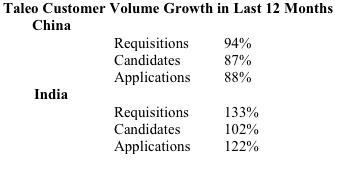
. Alice Snell summarises trends perceived by her firm in China & India. The scene in India suggest that there is a near explosive growth on hiring.
In a NYTimes interview, Mr. Azim Premji says that the important thing about outsourcing or global sourcing is that it becomes a very powerful tool to leverage talent, improve productivity and reduce work cycles. The West is not producing enough engineers. The United States will produce 75,000 engineers this year; they will produce more sports therapists than engineers. Germany, the great engineering power of Europe, will produce 35,000 engineers this year; they will produce more architects than engineers. While the numbers may be slightly more, it does indeed convey the message. With higher educations becoming more commonly available, the indications are getting stronger and the trend is clear. That does not mean despair for western economies. Even while rising tides of cheaper technical talent create greater innovation opportunities, transforming educational capacity into sustainable economic prosperity is not just a plain equation. I still believe that entrepreneurism and dynamic readjustements would help the US to be a very competitive nation in future as well. I do not think that it needs to be seen as one-or-zero situation. As I wrote earlier, the US is the economic engine of the world – lets hope that it continues to innovate faster, better and emerge stronger. Collaboration in innovation is always a workable solution. Together with the Asia let more innovation blossom and let the world prosper a lot more - innovation and prosperity are closely related.
The HP Scandal is getting more and more messy. I am a little surprised as to how different piece of information relating to the same issue can keep appearing daily –that too from very wide sources. Sensationalism apart – the concern here are far too more serious: Internal emails from HP allegedly point to a new set of players in the company's controversial leak probe, three major U.S. papers report today. One paper ties the probe to the highest corporate level, and the other two point to more specific names. All this while federal and state criminal investigations continue their investigations.
The story details HP's attempts to infect Cnet reporter Dawn Kawamoto's computer with software that would track who she sends a planted email to. Dunn and Hurd enthusiastically approved the plan, according to emails obtained by the Post!! HP CEO thinks that this has nothing to do with the strategy or operations of HP and adds that what began as an effort to prevent the leaks of confidential information from HP's boardroom ended up heading in directions that were never anticipated. Well, the stockmarket thinks of this otherwise - in this case the market may be sending the right message to the board members of HP.
To be truly successful, corporate philanthropic programs must be woven into the fabric of the organization. The easiest way to do that? Start from the beginning. Shortly after we started Salesforce.com in 1999, we launched the Salesforce Foundation with 1% of the company's stock. As chief executive, I made a commitment to donate 1% of company profits to the community (through product donations) and 1% of employee working hours to community service. The 1-1-1 model - equity, profits, and employee time - ensured that as our business grew, so would our contribution to the community. By leveraging the energy of our entire ecosystem, we have been able to make contributions that have exceeded expectations.
The team was managing cost instead of managing service and quality. It's totally the wrong answer. Stop managing for cost. Manage for a great experience. On rethinking things: This has been a wake-up call for us. We're using this whole period as a time to reexamine every part of the company. If you ask, "Is Dell in the penalty box?" Yeah, Dell's in the penalty box. Then we'll use this opportunity to fix everything.
The case of southwest airlines leveraging technology in a judicious way is by now legendary. Almost a fortnight back, when I missed my flight SQ flight from Singapore to Bangkok, I decided to try my luck with Jetstar – as I had to reach Bangkok urgently and it happened to be the earliest flight to depart. Upon enquiry, I was pointed to the Jetstar counter for buying a ticket, where I noticed that the executive in the counter on seeing me and enquiring with me, carried a laptop, installed it and began to check for seat availability – I was amused( afterall we are used to seeing big big boxes used for all airline operations) and till I boarded the flight, I noticed that the airlines operated in a very lightweight model). I thought one day, I shall talk to them to find out about their technology strategy.Stephen Tame, CIO Of Jetstar, a budget airline in Asia Pacific region offers good insight in the way he manages his IT investments. I like his idea of simplicity and managing the IT costs in a pragmatic way – his emphasis on running a 97.5% airline looks very interesting. He finds that virtualisation provides them with the flexibility to deliver those applications outside of the Jetstar world to those areas where it needs to do business like in dealing with a lot of common user, or non-Jetstar equipped locations. He adds that by rolling out thin-client machines - again virtualising the applications, direct bottomline benefits could be realized and he is talking about benefits measuring to 60% in maintenance and management costs. His theory of increasing IT spend by 40% to 50% more every year while bringing the IT expenditure percentage down is quite interesting. From 1.6% of total revenue to 1.2% percent projected next year. He is talking about possibility of losing systems at an airport for a day, and going manual at that airport and still being normal, is quite a task indeed. The pen as the technology and the enlightenment that IT can add complexity, it can add cost, and it doesn't always contribute to success is indeed very true in many organizations. End of the day IT ought to be tried where possibilities of significant synergies and efficiencies exist. The whole interview with good insights about outsourcing and managing with right metrics makes this a great read.
The cardinal rule with most startups : the technology/product development can be an iterative processes; but business plan shall remain anchoraged. The tale of Riya, an internet start-up, is a good one. Riya's Munjal Shah, has published the iterative approach they’ve taken to developing Riya’s business plan - read all the five parts. Peter Rip,an investor in Riya, discusses the change in business startegy in a post titled “The Riya Pivot”: I particularly liked his writing - Riya “launched with one thesis, but went back to the drawing board to re-invent the business a mere six weeks after the launch.” He adds, The Riya 2.0 is nothing like the Powerpoint seen an year back and it iwas very different from the few quarter old whiteboard discussion notes. But this is the nature of early stage consumer. Change Happens. Iterate. Pivot. Evolve He describes a number of areas that got clearer in 18 months after launch. Surprisngly, most of the chnage happened on items integrated within the businessplan. Frankly speaking, this is not bad at all . Its part of a rightly focussed startup organization - there won't be any well defined path for getting business and growth. Look at it closely : most of the improvements relate to things that need to be catered to as things move from an ideation stage to business lauch phase. This may support the idea that sometimes, it may be prudent to raise additional cheaper money at this stage rather than raising around 20 million early enough. Entrepreneurism brings out so much of discussions and action..
The SF Chronicle writes about the controversies now jolting Silicon Valley and woriies about the fallout of its dented image.
Corporate spying: Hewlett-Packard has revealed that it hired private contractors who impersonated HP directors, journalists and employees to get phone companies to turn over detailed logs of their home phone calls. Options: More than 100 companies, many in Silicon Valley, are suspected of manipulating option grant dates to enhance the value of stock options awarded to executives and other employees. Dozens of companies - from Silicon Valley startups to household names like Apple Computer - are either under investigation or conducting internal reviews. Many are restating earnings and facing higher tax bills.
As I see it, while issues around options and corporate scandals are quite despicable, fact remains that the silicon valley is the hotbed of technology, applied creativity and the nerve center for tech system progress. Where in the world can one find such a charged up environment - maintaining that edge for quite a while. As an aside, Bangalore/other Indian cities shows some very positive traits - last week a meeting that I addressed in bangalore, saw overflowing crowds and surprisingly,a clear indication of the growing tech ecosystem there. I met with a number of entrepreneurs, some of them working on leading edge areas. I also noticed that the focus was mostly on engineering and product features, not on the next big idea - but things show definite signs of progress therein. The sort of tech related deals that are getting closed for venture/early funding in India are definitely significant. However, for now, I firmly endorse the view about the silicon valley edge, it shall continue to be the springboard of innovation and technological advances for some more time to come. I definitely see that the india and to an extent china may begin to offer credible competition. The valley is also part of the great american ethos where the propensity to try out new things are very high and these feed each other. True,some shameful things are happening there now - but these can change. Time that this energy and momentum in the valley is preserved - in a legalistic way and in a trendsetting manner in all respects - tech advances and corporate behaviour included. This is vital for the global progress.
The Indian mobile market is on a high growth trajectory. I was in two different Indian cities last week – part of my 5 day - 5 different city tour across Asia. While in India, I was told by my colleagues that the mobile telephone network connectivity has become so bad that connections are dropping often. I was in KL for a day, while discussing with friends, a malaysian expert told me that the prospects of two major Malaysian telecom operators look good owing to their investments in India. I was in a lunch meeting with a senior executive of a major South east airline the week before in Singapore - the most talked about topic over lunch was the advent of indian aviation players creating ripples in the market. I was floored by the experience flying Jet airways in the chennai - KL flight. My colleagues ask me to hold judgement till I get to fly Kingfisher. Am not someone to be impressed so easily - my frequent flier statement shows several hundred thousand miles with none other than Singapore airlines. It is very likely aviation shall do an impressive repeat of the success of the mobile industry. Lets look at the Indian telecom scene : South east asian telecom operators have made significant investments in Indian mobile service players. These players took stakes in established growing business. Maxis, Malaysia’s largest telecom player has invested in Aircel and Singtel has invested in Bharti, the largest mobile player in India. As these players slug it out, Maxis reports that Aircel added 588,000 new subscribers during the second quarter alone, which is more than double Maxis' achievement in Malaysia. The other Malaysian player Telekom Malaysia is investing in the third Indian Indian player – Spice communications. All the three are aggressively expanding their Indian operations. Monthy subscriptions inching towards six million additions per month- 5.9 million of them are new mobile subscriptions making India’s net addition the highest in the world overtaking that of China – thought the penetration levels may be lower. Courtesy of Manish saw this – China added 5.1 million subscribers, so the Indian run rate is 15% ahead of that of China. Look at the growth – around 125 million subscribers have signed for mobile services in less than 15 years since the services were launched in the country. India beleives that six /seven million monthy new subscriber additions are possible. Clearly liberalization, foreign investments all are helping the country in a big way – after all the Indian mobile subscription rates are amongst the lowest in the world and handset makers like Nokia are helping the cause by coming with low cost models and in the process helping India create high tech manufacturing clusters in places like Sriperumpudur - India’s likely answer to Shenzhen. Three types of operators are alreasy investing here – The OEMs like Nokia, Motorola, The EMS’s like Flextronics & Foxconn & the component manufacturers who work with the OEM & EMS players. Dell is the recent addition planning to set up a manufacturing shop there. Its the most talked about thing in the tech sector today - some of the largest telecom related opportunties for system integrators/service players are available in India. Clearly opening up of the economy and the progress of the technology world is helping India advance faster and better - the only eyesore is the indian infrastructure - I do not want to write about my experience in the Bangalore airport clearing baggage or the time that it took for me in clearing immigration on my return via chennai.
"As venture capitalists scramble to throw money at anything labeled Ajax or Web 2.0, and Web publishing becomes so simple that anyone with a working mouse hand can put up a site, we offer our list of the 25 worst Web sites of all time. Many of our bottom 25 date from the dot-com boom, when no bad idea went unfunded. Some sites were outright scams — at least two of our featured Net entrepreneurs spent some time in the pokey. Others are just examples of bad design, or sites that got a little too careless with users' information, or tried to demand far too much personal data for too little benefit. And to prove we're not afraid to pick on somebody much bigger than us, our pick for the worst Web site may be the hottest cyberspot on the planet right now."
Jakob Nielson once wrote that the average difference in measured usability was 68% when comparing two competing companies. Also to note is the fact that studies show that 36% of Internet users are now in Asia and 24% are in Europe. Only 23% of users are in North America. This also adds to complexity in providing a consistent user experience. As I see it large enterprises, are currently suffering owing to doing a less than good job of providing a useful and usable Web experience to their customers and are on a race to make the web deliver for them better.Customer experiences range from supporting multichannel campaign management, customer self-service,call center knowledge management, direct marketing and as we move forward,Integration of Internet technologies into everyday life that does not involve a desktop or even a mobile/cell/PDA are all real possibilities. The growth in the website technology market suggest that the replacement market for websites are heating up s enterprises look for innovation . Many large vendors may be looking at acquiring the web spaceowing to its high growth potentail.I hold the view that it is far more prudent to look at web medium as more of a strategy & not as a technology.
Just came across the the State of Web Development 2006 jointly compiled by Sitepoint and Ektron – it makes interesting reading. Some of the views expressed therein about the future of the web indeed makes interesting reading. The importance of the web is given – its truly becoming a reflection of, and enhancement to, our world. It connects us, binds us, enables us and empowers us. One viewpoint that comes therein is the idea of pervasive web with total immersion. Mobiles, PDA’s, laptops, PCs, TVs – so many different ways exist to access the Web and more are added every day. As we move forward, Integration of Internet technologies into everyday life that does not involve a desktop or even a mobile/cell/PDA are all real possibilities.
More importantly the report talks about survey results taken from polling 5000 developers and internet professionals and report increasing adoption of open source CMS. Of equal note is the expectation that collaborative technologies are expected to play moving forward. Ajax is being looked at for engagements by almost half of the developers, with blogs (38%), podcasts (25%), wikis (20%), syndication (36%), and other features increasingly planned to be integrated into websites.
Some may interpret this as a proof of increasing adoption of open source in the applications space. While open source dominance in the infrastructure arena is given, I do not see any great wave in open source adoption, though the technology in the web content management space is closer to open source infrastructure technology and hence there may be some marginal impact there – more so with small business/academic institutions looking at it. I would have attached more importance to a report based on a survey administered to CIO’s. I also see that some SaaS based solutions may make some inroads in this space. As I see it large enterprises, are currently suffering owing to doing a less than good job of providing a useful and usable Web experience to their customers and are on a race to make the web deliver for them better. From a technology vendor perspective, the growth in the market suggest that the replacement market for WCM will heat up as enterprises look for innovation . Many large vendors may be looking at acquiring specialized vendors operating in the WCM space. My suggestion to customers, is to look at ECM as more of a strategy & not as a technology.
The folks over at Slate have published a series of mails exchanged between HP board member and venture capitalist Thomas Perkins and HP attorney Larry Sonsini. Going through the email thread, one can see that Perkins gets outraged – on the pretext monitoring unleashed on their board members. Perkin says that the whole investigation was a Pattie Dunn program -100% conceived & managed by her, and unknown to the board, except in the most vague and imprecise terms!! The best part is when Tom asks Sonsini about the program and the attorney at some point says that keeping mouth shut may be a better policy!! Sonsini is at his best when he completes a thorough investigation and concludes that HP did not do anything illegal. Crazy to say the least.
Some trendwatching about the IT services & BPO. Shorter contracts. Multiple vendors. Continued talent shortage. More work for India – and some for China and “nearshore” destinations too. Read the full note here.
Andrew McAfee writes that it’s time to look at a narrow definition of Enterprise 2.0 and not as seen here by MR and Vinnie. I reread all the three pieces – by MR, Vinnie and Andrew and feel that the professor is missing the point. From his perspective he sees Enterprise 2.0 communicates all about changes to collaboration, not to development or delivery models. He explains
Tags, for example, are visible to end users; Service-oriented architectures are not. Enterprise 2.0, as these folk and I define it, is a trend that we think should be on the radar screens of non-technologist business leaders. Talking about development models and delivery methods is a good way to ensure that it doesn't get there, or doesn't stay there long. Business leaders' eyes will glaze over, or they'll quickly mentally file the topic as "something for my tech team to worry about."
Enterprise 2.0 has got to be all encompassing and as wide as possible but need to be determinstic and thats what MR's characterization of enteprise 2.0 seems to suggest - a role for all relevant elements and the effects of their confluence. I am sure Professor andrew would agree that if his argument is extended, tags(which he characterises as an element of Enterprise 2.0) would definitely not make it to the list to be considered by business leaders.
Actually Andrew’s perspective looks far too narrow to make any sense to business. Ultimately any initiative needs to be funded by business and I do not agree that business leaders would not be concerned about development models and delivery methods. Next time when Harvard organizes a training program for CEO’s on global delivery methods – Andrew can see the interest shown in such programs. Matter of fact global delivery has long become a boardroom issue – most of the push to offshoring came from the business leaders and not from technologists!! After all delivering innovation and quality improvement costs money and these needs to factor in delivery models and development methods. Every time,I meet a business leader, invariably, I am always asked the question how do we manage IP breach issues in China or how do organizations manage delivery out of Asian locations besides India. After all delivery mechanisms are like extended value chains for services and as such are a strategic weapon and therefore a direct board level responsibility.
Capgemini buys 51% in Unilever's India BPO screams the headline all over. The Unilever India Shared Services (Indigo), is a captive BPO company set up by Unilever in India with around 600 employees in Chennai(India)at its development centre. The captive centre carries out finance and accounting-related processing for Unilever companies in 45 countries. Paul Hermelin, CEO of Capgemini, says that he would look at acquiring the remaining stake at a later date. While the cost of the acquisition(sellout?) was not known, it is expected that since the deal includes the price of acquisition of the stake and a revenue contract for future business, the total cost may not be very high.
On Valuation : Indigo had revenues of Rs 22.3 crore for the year ending December ’05. with the average per head revenue of Indigo at e20,000 (Rs 17.4 lakh). Since captive BPO units are primarily cost centres, revenues or earnings are not likely to be the relevant benchmarks in valuing the deal. Instead, the valuation is likely to be based more on land, building and other infrastructure. The news also said that Capgemini and the Unilever group have also entered into a seven-year agreement to deliver the full range of BPO F&A services to all the Unilever companies, which Indigo currently serves.
As I see it, many are looking at this as a strategy beneficial to CG for scaling up in India. I would also urge readers to look at it from a different lens – that of HLL, Unarguably India’s corporate icon and Unilever’s crown jewel would not have taken such a decision without working out its near and medium term benefits. Its likely the case that HLL must have thought that sustaining captive BPO center may not be the best option available in front of it – seem from an expertise, economics and scaling up perspective. I like Lever's approach - unlock the value/renounce management control where the operational challenges can not be managed with its existing core competency. There are lessons for several multinationals who are setting up /scaling up their captive centers in India. No MNC can understand India better than Unilever. HLL has been in the country for several decades and is perhaps the largest non government/oil/IT services corporation in India. As I wrote earlier, while captive option may look attractive for some software product vendors/others in a limited way and for short duration, in reality, we see that captive option falls short on one most important dimension – arresting turnovers, repeatedly cited as a matter of concern, The ability to support a wide range of operations may also be doubtful with captive models. Dell may be the only exception. Those who look at offshoring as just a means to shave off some costs and hope to improve on savings with passing time would definitely fail to achieve their goal measured over a period of time, unless they manage to work on ability to manage it in a concerted way. In my experience, I find that maximizing productivity & minimizing risk - seems to be the most prudent option that enterprises choose to pursue while attempting Offshoring. The process of offshore outsourcing may be more evolutionary and a determined pursuit to engage more wide and deep would be a sure way to reap consistent benefits. I echoed similar views when I wrote when Apple chose to close down its India based support operations that there is no merit in keeping support as captive unit where scale is not there - whichever part of the world it might be - outsourcing support may be the long term option for Apple(all other industry majors across verticals)
WSJ quotes people in the know of things that there were criminal acts invloved in the methods used to search the collected recrods. Patricia Dunn should go writes David Kirkpatrick. Fully endorsed. The HP issue gets murkier. Its chairperson reportedly spied on the company’s directors by having their telephone conversations tapped. If these are true, it is very clearly unethical and perhaps illegal as well. The events are clearly full of shame. After all HP is a legendary company and the founders of the company were well known for their neat and clean approach towards conducting business. Ms.Dunn need not wait for the board to declare loss of confidence in her. She should be fired immediately. Too often the board fails to stand up and lead by example- this should not be tolerated any further. Board and its conduct are always answerable to shareholders and law. Its also definitely a good practice to have the CEO & Chairman of the board position kept separated.It is high time that HP stands up and in the process send a firm, loud and clear message that it is once for all putting behind the shame and agony of the ugly happenings centered around its board members. For a technology company, being able to hold privacy and being ethical, given that it operates around the world is an absolute must. There is no scope for any ambiguity in this case.It is high time that HP board shows that it can act decisiviely to put this controversy behind it and make a strong stand against any sort of unethical acquisition of personal information. One essential way to send that message is to get rid of Patricia. Otherwise this will remain a mess that impacts the great and clean reputation of HP.
Neil McAllister quotes from Eric S. Raymond landmark work, The Cathedral and the Bazaar, wherein he says that the most powerful motive for open source developers is the need to “scratch their own itch.” They begin writing software to address their unique needs. As they meet other like-minded developers, they begin to pool their efforts, forming communities. But itch-scratching only tells part of the story. The reality is that, in many cases, itch-scratching alone simply doesn’t work. Pointing out that the end-users in need of additional features are generally left in the lurch and given free advice to develop on their own and contribute , he correctly points out the realities open source faces, when extended to the enterprise. Even the most often talked Massachusetts decion in favour of using opensource has hit a snag now put on hold, Clearly Open source needs the contributions and sponsorship of private enterprises to succeed . He is right in his conclusion that’s the notion of open source as a socialist utopia is a misguided one. The question of business model still lurks large for the open source ecosystem. As I wrote earlier,the lack of stratified solution/support and the one size fit-all solution offering shall not carry conviction as a dependable approach in the enterprise space. The business model paradigm of open source players minus the much-touted entry price difference is hardly anything to write about.(In reality, there may not be much difference from a total-cost-of-ownership perspective - the delta, if seen, can be directly attributed to the stratospheric licensing and maintenance fees of commercial enterprise software players.) Software requires so much of associated work to be adopted for effective usage within enterprises adopting them - these can certainly not be coming form a commoditized family let alone coming from a mere standardized family. Enterprises adopt software to cater to support/enablement of differentiated processes and create distinctive value and a mere set of standardized mass developed software amenable for customization would hardly qualify to be called a solution fit for enterprise adoption.
Just wanted the readers of this blog to know that am delivering the Keynote address for the SFDC ondemand tour event and this is also in a way the official launch of SFDC in India & the event is in Bangalore on Sep 12. The theme of my presentation is -"SaaS as the next big thing". Most of you may know that I work for satyam, by far the largest offshore player in the consulting space centered around packaged solutions. I do not want to do any more promotions. I generally do not write about what I do and where I work etc etc in this blog. All my blogging efforts are totally private and not related to satyam in anyway and I hardly write about my employer in my blogs. The reason for this note is that if by any chance, anyone of you are going to be in Bangalore on Sep 12, hope to see you there and the event is in Taj West End.
Fred started a discussion today around the value of YouTube and strategies to monetize online video. He thinks that YouTube could be generating $440 million in annual revenue after factoring the effects of unwanted content and user generated high quality content. I think all this is totally theoretical – many of the content in sites like Youtube are so non viewable grade for common users, the volume projections look so bizarre. I think probably less than ten percent of videos may appeal to all – its like a search engine – practically results appearing after page 6 may not get much visitors. It was wonder when i read that YouTube is waiting for the payoff. I somehow think that all these big numbers may not matter much at all as we can not extrapolate existing revenue models to near disruptive technologies like Youtube. Clearly yesteryears models of monetization may not be fully relevant when the media business embraces new waves of business. It also needs to be seen how much one be willing to pay for one way ads – adsense makes money because of its dynamic nature of generating relevant ads. I agree with this perspective on the way forward for Youtube. I just want to repeat what I wrote about another passing fancy – rocketboom wherein I noted that while the bullishness is based on user generated content and it associated premium value, I am not too enthused about user generated content itself given the proliferation of electronic media and rendering devices. If Rocketboom were to work on creating heppy quality content, then they are in an head-on collision with the traditional media – far more resourceful and showing signs of great dynamism and it they are just going to rely on user generated content, once can’t escape the fact that reality will dawn upon them as is happening with the likes of youtube. The hyped up Skype’s, Flickr’s provide ample lessons. A look at the way the posterboy of internet era - Amazon & its stock movement tells it all. Interestingly Amazon is entering somewhat related line of business that YouTube is currently in.
Schachter says he looked at bookmarking for two reasons: for future reread if one likes it or marking it for a future read when you do not have the time now. The question of managing them becomes more critical and by making memory scalable through usage of technology del.icio.us found a scalable solution. With volume usage, all those individual tags created a useful system for categorizing Web pages. On the surface, del.icio.us doesn't seem designed to do this, since each person makes his or her own tags, and there's no overarching authority to maintain order. But even with no one in charge, the product of all the individual decisions of del.icio.us's users is surprisingly well organized-and surprisingly intelligent. That is, if you do a search on del.icio.us for all the pages that are tagged with a particular word, you're likely to come up with a remarkably good and well rounded selection of related Web sources. In other words, although del.icio.us didn't need lots of users to be useful, once it had lots of users, it became valuable in an entirely new way. Almost accidentally, it became an excellent tool for making sense of the Web.
The real magic of folksonomies-and the reason sites like del.icio.us can create so much value with so little hired labor-is that they require no effort from users beyond their local work of tagging pages for themselves. It just happens that the by product of that work is a very useful system for organizing information. This distinguishes del.icio.us from other high-profile Web 2.0 sites like Wikipedia and Digg, which people contribute to without reaping any obvious personal benefit. No wonder that there wer so much indignation. In contrast del.icio.us always gets a clean image association.One would like to see how Yahoo effectively steers this powerful tool moving forward.
C.K.Prahalad writes in detail with specific examples and a contextual framework on hoe the bottom-of-the-pyramid" model can foster the creation of what he calls "an impossibly low-cost, high-quality new business model." He thinks that working with and around constraints is the key towards success. CK refers to success stories in the hospitality & healthcare sectors in India and points to a few other companies operation on the innovation sandbox paradigm to success.
CK, well known for his repeated emphasis on the next practices instead of best practices showcases the Indiaone hotel as an example – the hotel charges $20, a fraction of what other western chains charge for customers in Bangalore with no compromise on the range of services. He sees that in the modern Indiaone hotels every room includes an attached bathroom, an LCD television, a wireless broadband connection, a small refrigerator, a coffeemaker, and a work area. The common areas include a pleasant cafeteria, an ATM, a business center, and a small gym. The hotel is very profitable. Its gross margins were 65 percent in 2005, compared with 30 to 40 percent for typical luxury hotels. And the business model is scalable. Ten such hotels are springing up this year in India, and another 25 are planned. His other examples like Aravind eye care system are indeed powerful ones.
The message from Prahalad is that all industries can try and achieve similar things but there are four conditions that must be present for similar types of breakthrough innovations to occur: The process for designing both of these breakthrough innovations started with the identification of the following four conditions — all of which are difficult to realize, even when taken one at a time: 1. The innovation must result in a product or service of world-class quality. 2. The innovation must achieve a significant price reduction — at least 90 percent off the cost of a comparable product or service in the West. 3. The innovation must be scalable: It must be able to be produced, marketed, and used in many locales and circumstances. 4. The innovation must be affordable at the bottom of the economic pyramid, reaching people with the lowest levels of income in any given society. In countries like India, with 700 million bottom-of-the-pyramid consumers at varying levels of income, the need for innovations that meet these criteria is now becoming obvious . He sees that the innovation “sandbox” involves fairly complex, free-form exploration and even playful experimentation (the sand, with its flowing, shifting boundaries) within extremely fixed specified constraints (the walls, straight and rigid, that box in the sand). The value of this approach is keenly felt at the bottom-of-the-pyramid market, but any industry, in any locale, can generate similar breakthroughs by creating a similar context for itself.
While the whole article is quite an insightful one and it makes interesting read – I particularly liked this one - The multinational corporations may find it hard to embrace these approaches, as the dominant logic of successful companies are so well entrenched: the business practices that have been successful in the past, the mind-set tied to those old practices, the internal evaluation systems that reinforce this mind-set, and the daunting problem of lack of experience in the new way of operating. CK, would know better than most others – he sits on the board of HLL , an unilever subsidiary – but for all practical purposes run as a separate local company and in the process creating a powerful identity for itself besides being hugely successful. The zone of comfort drives away the zone of opportunity. This is certainly true as offshoring majors are clearly demonstrating against the global service providers and am also hearing views about how the next wave of innovation may make a dent on the fast growing and well entrenched service majors. Asian Innovation, always had a different recipe and not many western enterprises understand them sufficiently to leverage better. Several months I came across this reasoning -"the presence many multinationals have established in Asia is more suited to prospering in yesterday's competitive environment rather than being well attuned to winning in the next round—especially against the new breed of Asian multinationals that seems likely to evolve as Asian companies rise to the challenge of inter-nationalization". Clearly, thinking global, acting local the article goes on to explain means that best practices and innovations generated in the course of adapting a global business formula to a local market remain imprisoned locally: They don't get propagated across Asia and the world. While this remains the case, Western multinationals in Asia won't be able to fully exploit the learning they are accumulating inside their Asian operations. The long-term consequence of this failure will be an inability to keep pace with their Asian cousins as they become increasingly capable of taking what they learn in one Asian country and deploying that learning elsewhere. In short, while Asia remains a recipient and implementer of best practice within Western multinationals rather than a strong contributor to global improvement and innovation, their competitive advantage will erode relative to Asian rivals capable of milking what they learn in Asia for all it is worth. I firmly beleive that colloboration in innovation would certainly help but a mindset change towards the asian microcosm may be the first step towards that..
Stock option plans reward the executive for doing the wrong thing. Instead of asking, 'Are we making the right decision?' he asks, 'How did we close today?' It is encouragement to loot the corporation.
Stock options and high tech industry are becoming almost synonymous- everywhere I turn, I hear the stores of rags-to-riches stories based on tech stock growth. Most executives inside tech companies are so brazen in capitalizing on their stocks that several managerial decisions/career moves are centered around stock options. It may be true that high-tech start-ups,and severely capital-constrained organizations cannot afford to ignore market pressures for short-term performance. Every new hire today wants to know his/her stock entitlements. Thomas Stewart in this month’s editor column of the HBR issue picks up the issue of executive compensation and in particular about the stock options. He contends that while originally aimed at aligning manager’s action with that of owner’s in effect it is aligning with the interest of the traders. He asks a rightful question – if the goal is to make managers as shareholders, why not just pay them half their compensation in company stock itself, bought in the market at the start /end of every month. Inside, Alfred Rappaport has a thoughtful article on ways to increase shareholder value. He argues that executives have developed tunnel vision in their pursuit of shareholder value, focusing on short-term performance at the expense of investing in long-term growth and opines that it's time to broaden that perspective and begin shaping business strategies in light of the competitive landscape, not the shareholder list. He offers 10 basic principles to help executives create lasting shareholder value. For starters, companies should not manage earnings or provide earnings guidance; those that fail to embrace this first principle of shareholder value will almost certainly be unable to follow the rest. Additionally, leaders should make strategic decisions and acquisitions and carry assets that maximize expected value, even if near-term earnings are negatively affected as a result. During times when there are no credible value-creating opportunities to invest in the business, companies should avoid using excess cash to make investments that look good on the surface but might end up destroying value, such as ill-advised, overpriced acquisitions. It would be better to return the cash to shareholders in the form of dividends and buybacks. The story of Berkshire Hathway illustrates the application of such principles. Rappaport also offers guidelines for establishing effective pay incentives at every level of management; emphasizes that senior executives need to lay their wealth on the line just as shareholders do; and urges companies to embrace full disclosure, an antidote to short-term earnings obsession that serves to decrease investor uncertainty, which could reduce the cost of capital and increase the share price.. Indeed an excellent read. I routinely hear that come jan/june, most key guys would have vested majority of options and so goes the common talk.. then comes the next tranche and life goes on.. Far from helping create value for shareholders, I observe in many cases, options impede dynamism. Stock options are sometimes jokingly referred to as "golden handcuffs" (in the same vein as golden handshakes or golden hellos), especially in a strongly rising market - the employee may feel compelled to work out the time until they are able to liquidate the stock even if they might otherwise prefer to leave the company. I see that there are several walking-dead executives in companies hanging on aimlessly and waiting for the vesting period. Several others may have to await their turn to get eligible for the feast. Looking at the story of several tech dinosaur’s Peter Drucker is indeed right. Stock options are a case of good intentions gone bad.Time that stakeholders and the board raise the right questions and deliberate on such issues.
Google launches News Archive Search. This lets you search back over twenty decades worth of historical content, including content that were not previously available via the search engine. Archived news results can be found in three ways. You can search the news archives directly through a new News Archive Search page. News archive results are also returned when you search on Google News or do a general Google web search and your query has relevant historical news results.
Searchenginewatch adds that both free and fee-based content is included in Archive Search, with content from both publishers and aggregators. Search results available for a fee are labeled "pay-per-view" or with a specific price indicated. Google does not host this content; clicking on a link for fee-based content takes you to the content owner or aggregator's web site where you must complete the transaction before gaining access to the content.A quick view shows that the search results look similar to those produced by a search on Google news, along with a few additional time-related features. It is interesting to see the way how the system shows the progressive build up of topic/event over time. The "timeline" link reorders results in chronological order; you can then drill down to get content from specific dates simply by browsing and options available to limit search results to a single day as well. Google explains the features as : - Search diverse sources from one place - Browse timelines of events and stories related to specific queries - Identify key time periods relevant to persons/events/ideas - Discover a variety of viewpoints across time Some libraries indeed provide to subscribers free search results whereas Google may make these available on a as –you-use - pay basis. While Google may like to say that it has not finalised on monetisation of this service, it it clearly a fit case to assume that a new revenue channel gets opened for Google. No doubt this is an incredible advance. Also to note is that Google scholar search was notexactly such a great hit. Search results have suffered on account of lack of such features and generally currnetness preced importance or pushed old information out. This is likely to become a very used service, coming as it is from Google.
Just landed in singapore after a 12 hour flight from Newzealand and saw this definition of Enteprise 2.0 from MR. He writes that just as e-commerce, Web 2.0 or "Software as a Service" has laid the foundation for the birth of an entire sector-full of product lines and new companies, Enterprise 2.0 will do the same. He is spot on - Enterprise 2.0 is more than just Web 2.0 for business. Enterprise computing is far more complex than personal computing. It includes legacy environments, innumerable vendors, mismatched data sources, stringent regulations and far flung users. While Web 2.0 can deliver genuine advantages for both business users and consumers, the real "Enterprise 2.0" will encompass a far broader and more complex vision. I particularly liked the Enterprise 2.0 chart therein. Must read piece.
Courtesy of Vinnie saw this Fortune article on expected indian growth and how this may beat the chinese growth. I have seen Vinnie's well meaning view on this as well. I travel often to China & India and have a certain feel of the situation. I routinely speak to very senior executives of Japanese, Korean eneterprises as well to understand their perception on this issue besides my regular interaction with global tech folks.There is no simple answer to this conundrum. However, I do feel that the Indian growth would be more broadbased and more progressive while the chinese would not yield on letting the steam off. I think that ultimately the instituitional strength of India - particularly in the financial sector may slightly tilt things towards India in the next 15 years or so. India is now almost ready for current account convertibility. India also needs to think big and break out of the humility gene syndrome. Also there is a near absence of managerial talent in china - but the chinese governement is hyper aggressive in pursuing growth. I do think that demographics may play a role here. However I must say that the chinese capability to build huge infrastructure and create a megacity in a decade, is something that India may not be able to match in the near future. May be there is no need to compare the growth of these two large nations. They have to grow a lot more for years to come to take millions out of poverty. I am off to NewZealand shortly - shall write in more detail on this topic later.
The private equity wave that I wrote about is beginning to be felt visibly.I was just speaking to a very senior industry executive a few hours back after my long travel and the common thread of the discussions were about how private equity investors are seriously looking at acquiring undervalued companies. Here comes the announcement that Intergraph is being acquired by an investor group led by Hellman & Friedman LLC and Texas Pacific Group in a transaction valued at around 1.3 Billion, approximately 3X sales. Intergraph apparently brought in their CEO Halsey Wise to increase shareholder value, settle the intellectual property law suits, and dress up the company to be attractive for takeover. In general, equity investors are drawn towards companies that show a lot of free cash flow and that which has parts which can be profitably hived off to achieve higher returns on investment. In this case their GIS division could be acquired by an enterprise major – Hopefully oracle /Microsoft /SAP may find it attractive. There is also a lot of talk in the streets about private equity moves in the Indian market centered on offshoring companies. I suspect this may be tough as the regulations are not exactly friendly to private equity players . For example share buy back is not allowed – promoters may not agree for a complete relaxation of the regulations unless buy back provisions are allowed. Some in the Indian technology industry were happenstance entrepreneurs in this field – so they may find it attractive to exit- afterall the infrastructure sector looks so attractive for new ventures inside the country. Certainly, one can expect more action centered around private equity in the tech sector.
I recently wrote that I have started reading the book Eimona. Amidst my hectic travel and a punishing schedule, just managed to finish reading the book. G.B.Prabhat, the author of Eimona, has impressive credentials. He is the pioneer in offshore consulting business and a well known name in the global IT/Business Consulting space. Eimona is his second novel and after an interesting opening rapidly paces to an amazingly engrossing read - very rich in words and full of events - suits itself for a non stop read. The humor and the depth in characterization, the distinct messages/thoughts centered on each of the characters are indeed quite telling. The new flat world is forcing disparate cultures to come together in an enmeshed way – with prosperity, business accelerating the pace of life like never before resulting in practices and events that were unthinkable a couple of decades back. These happen quite routinely and have the potential effect of denting the fabric of societal and traditional family values. Eimona is certainly amongst the early attempts to capture and bring out in its own brilliant way that these advancements come out with a tradeoff. Invariably society and most individuals pay a price for pursuing things that are centered on things like live for the moment, or follow the group syndrome and the deleterious consequences of the mechanical life with plastic smile ensconced with artificial values generally follow. Prabhat’s work is woven brilliantly combining wit, humour, false values, aimless materialism, simplicity, virtuous life and raises serious questions. The novel is set in Madras in India and captures the nuances of Eimona, a place that does not physically exist in any of the continents but alas is perhaps existent everywhere in this flat world. Clearly the message is universal, while the setting may be contextual.
What is Eimona ? It is the reverse of anomie – an affliction that causes the victim to have social interaction that’s lower than the usual standards in the group, a sort of rootlessness. By seeing through the eyes of Subbu, the eighty four year old, simple man, the world as he sees it is changing so fast in all its facets that established norms turn upside down. The way the change in norms are captured and presented makes the reading quite absorbing – filled as they are with good humour and deeply thought out observations. Most of these are brought out as Subbu’s mind goes back and forth and assesses events and happenings based on new norms and bring out the conflict between the New India of stock options and artificial values while the society does not fully want to get rid of the flavors of the Old India.. The cold blast that hits Subbu in the form of the nature of fortunes that get built in millions based on stock options, the changing landscapes of residences when nature in its closest form at distance has not changed a bit, the prenuptial agreements and the different business setup where the employed and the organization have a purely contractual relationship etc – all these make reading of the novel, a very meaningful exercise. For example when his great granddaughter is born – he worries that she should not be named with the new economy tongue twisters – Vrimnolika, Karnishta or Avnita – he is relieved when she is named Maya , a simple but traditional name. Subbu, who has seen so many of his family members gone for ever in his lifetime dotes all his attention on the eight-year old Maya, his great granddaughter. The powerful characterization in the form of the ever uncertain – Bharat, a successful investment banker as his grandson and his personable but aggressive wife Indu, an executive in a software firm and the way the events move when she can’t accept their young daughter’s nonchalant attitude towards the eworlds modern tools – online chat, games and all other non-academic activities but is quite tuned towards nature loving activities and pursues simple interests, which transcend social class and technology barriers. A nature loving child becomes a problem child when she does not get attracted towards the net, expected of her in these times. Rule setting Indu wants to run the family with an iron grip – the same way she works in the office and that includes his old, suffering father, staying alone and who in the past had a great social and business life. Several of Indu’s action, so well brought out typically represents the false sense of righteousness that pervades the society and her own response towards sad personal events and partying life all make readers wonder and worry about the chaotic degeneration that we all see in our present day lives. Subbu also finds many modern day activities at odds with what he has seen in his prime time – every working day in any family, the apartment complex transforms into a bedlam of noise and confusion by seven thirty in the morning, only to become quiet and solemn in an hour. His concerns about the potential inequity that modern society is spreading and how the beneficiaries tend to over look it is a representative point about the type of issues that the novel seeks to bring out. Bharat’s inability to make up his mind – in moments of crisis – the appearance of Buridan’s ass and the tutorship he got that in the long run – the majority always wins – are all classic follies that we tend to see in modern life and the novel captures it at its essence quite well. What happens to the simple minded old man Subbu and his great grand daughter Maya closer to the end adds to the excitement in reading the book. Yet, despite addressing such serious issue of life, the novel has a well felt undercurrent of humour and coming out so naturally; it amplifies the effect of the book many times over. Eimona brings out quite fascinatingly many destructive shortcoming of the so-called meritorious society where conformance to the new norms is non-negotiable, however bizarre and anachronistic they might appear to the balanced mind. It pops up several questions that deserve to be answered by every thinking person. Combination of sharp observation and told in an eloquent style, liberally embedded with gentle satire, Eimona clearly qualifies to be the most representative story of the modern life and the digitized generation. It leaves a sense that we need to pause, reflect and question the happenings in the fast paced modern life and perhaps realign and revise the nature of the journey seeking more and more prosperity leaving with a taste of lesser happiness all around. Eimona may soon become a well spoken word as well, around the world. This is a MUST READ book – one can perhaps keep reading year after year. Indian readers can buy the book here and international readers can buy it here. Readers beware : I may not have done full justice in my review of the book, considering its class.
Sadagopan's Weblog on Emerging Technologies, Trends,Thoughts, Ideas & Cyberworld "All views expressed are my personal views are not related in any way to my employer"